
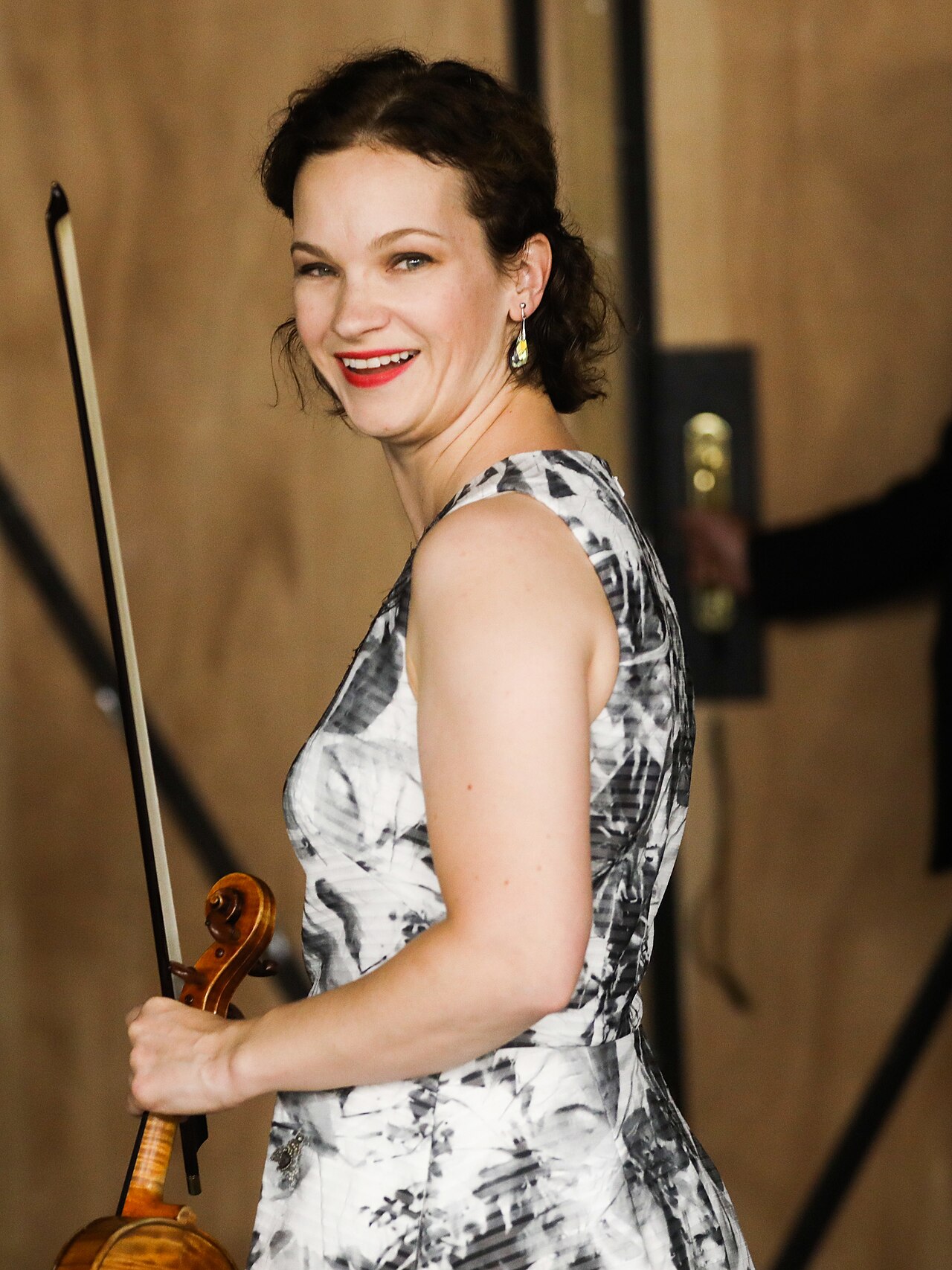
A seventeen-year-old violinist walks into a studio and records Bach’s solo partitas and sonatas. The result is a CD that moves over 500,000 copies. That debut, 'Hilary Hahn Plays Bach,' arrived in 1997 on Sony Classical, and it became a cornerstone of a career that bridged classical music into the digital age. Hahn, born on July 30, 1979, in Lexington, Virginia, had already been playing for over a decade. She picked up the violin just before turning four, and by ten she was at the Curtis Institute of Music in Philadelphia, studying with Jascha Brodsky, the last pupil of Eugène Ysaÿe.
A teenage prodigy bets on Bach
Hahn’s path was accelerated from the start. At eleven, she debuted with the Baltimore Symphony Orchestra under David Zinman. By fifteen, in 1995, she made her international debut with Lorin Maazel and the Bavarian Radio Symphony Orchestra. A year later, she signed an exclusive contract with Sony Classical. The label was betting on a teenager in an era when classical recording was already contracting. But Hahn’s first album proved them right. 'Hilary Hahn Plays Bach' spent weeks on the classical charts. Its success was a signal: a young artist could still move physical product in a CD market that was about to be disrupted by file-sharing.
The Bach album’s sound was intimate and unadorned, captured with a clarity that suited Hahn’s precise, singing tone. She played a Vuillaume violin from 1864, built on a Paganini model, with bows by the French maker Paul Jombar. The instrument’s dark, focused voice became a signature. That disc wasn’t just a collection of pieces; it was a statement of intent. Hahn wasn’t interested in flashy virtuosity for its own sake. Her Bach had a patient, architectural quality. It felt like a conversation with the past, but delivered in a format—the compact disc—that was still the dominant physical medium of the moment.
The Sony years and a growing catalog
Sony kept the release schedule tight. In 1999, Hahn followed up with an album pairing Beethoven and Bernstein, which drew critical acclaim. Then came a string of concerto recordings that defined her catalog: Brahms and Stravinsky with Neville Marriner and the Academy of St Martin in the Fields in 2001; Mendelssohn and Shostakovich with the Oslo Philharmonic in 2002; and more Bach concertos in 2003 with the Los Angeles Chamber Orchestra. Each CD built her reputation for thoughtful interpretations, captured in warm, detailed sound. Collectors began to track her discography, noting the consistent cover art and the careful sequencing of repertoire.
The mid-2000s saw Hahn push into less predictable territory. She recorded the Elgar Violin Concerto and Vaughan Williams’ 'The Lark Ascending' in 2004, then turned to Paganini and Spohr in 2006. The Paganini album, with its first concerto, was a test of pure technique, and Hahn passed it without turning the music into a circus act. In 2008, she tackled Schoenberg’s concerto alongside Sibelius, with Esa-Pekka Salonen conducting the Swedish Radio Symphony Orchestra. These were not safe choices for a classical artist on a major label. But Hahn’s approach—intellectual yet deeply felt—made them accessible.
Building a community beyond the concert hall
By the 2010s, Hahn was redefining what a classical musician could be outside the concert hall. She launched a YouTube channel, posting behind-the-scenes videos and interviews with fellow musicians. On early Twitter, she engaged directly with fans, demystifying the life of a touring soloist. In 2010, she started 'Bring Your Own Baby,' inviting parents to bring infants to her concerts. These moves built a community around her recordings. When she released the Charles Ives sonatas in 2011, it won a Grammy. The album, with pianist Valentina Lisitsa, was a deep dive into a composer often seen as difficult. Hahn made it sing.
Then came the experiments. In 2012, she recorded 'Silfra' with the pianist Hauschka, an album of free improvisation. It was a sharp left turn from her classical work, but it showed her willingness to explore sound for its own sake. The following year, she released 'In 27 Pieces: the Hilary Hahn Encores,' for which she commissioned 27 short works from living composers. The project was a bold statement about the vitality of new music. It won a Grammy for Best Chamber Music Album. The physical release, a two-CD set, became a treasure for collectors, with its booklet detailing each piece and composer.
Hahn’s relationship with Bach remained central. In 2018, two decades after her debut, she returned to the solo sonatas and partitas. The new recording, released on CD and vinyl, won another Grammy. Where the first album had a youthful clarity, this one had a deeper, more weathered beauty. The Vuillaume violin sounded richer, and Hahn’s phrasing had gained a new layer of introspection. She had taken a creative sabbatical in 2014, stepping away from the violin for months to recover from burnout. When she returned in 2015, her playing had a renewed sense of purpose.
Recent albums have continued to expand her range. 'Paris' in 2021 explored French repertoire by Chausson, Prokofiev, and Ravel. 'Eclipse' in 2022 paired Dvořák and Ginastera concertos with the Frankfurt Radio Symphony. In 2023, she released a disc of Ysaÿe and Chausson. Each release is a physical artifact of an artist who came of age in the CD era and never stopped believing in the album as a complete statement. For collectors, Hahn’s catalog is a map of a career that has bridged the twentieth century’s virtuoso tradition and the twenty-first century’s digital community. It all started with a teenager, a Vuillaume, and a Bach CD that refused to be background music.