
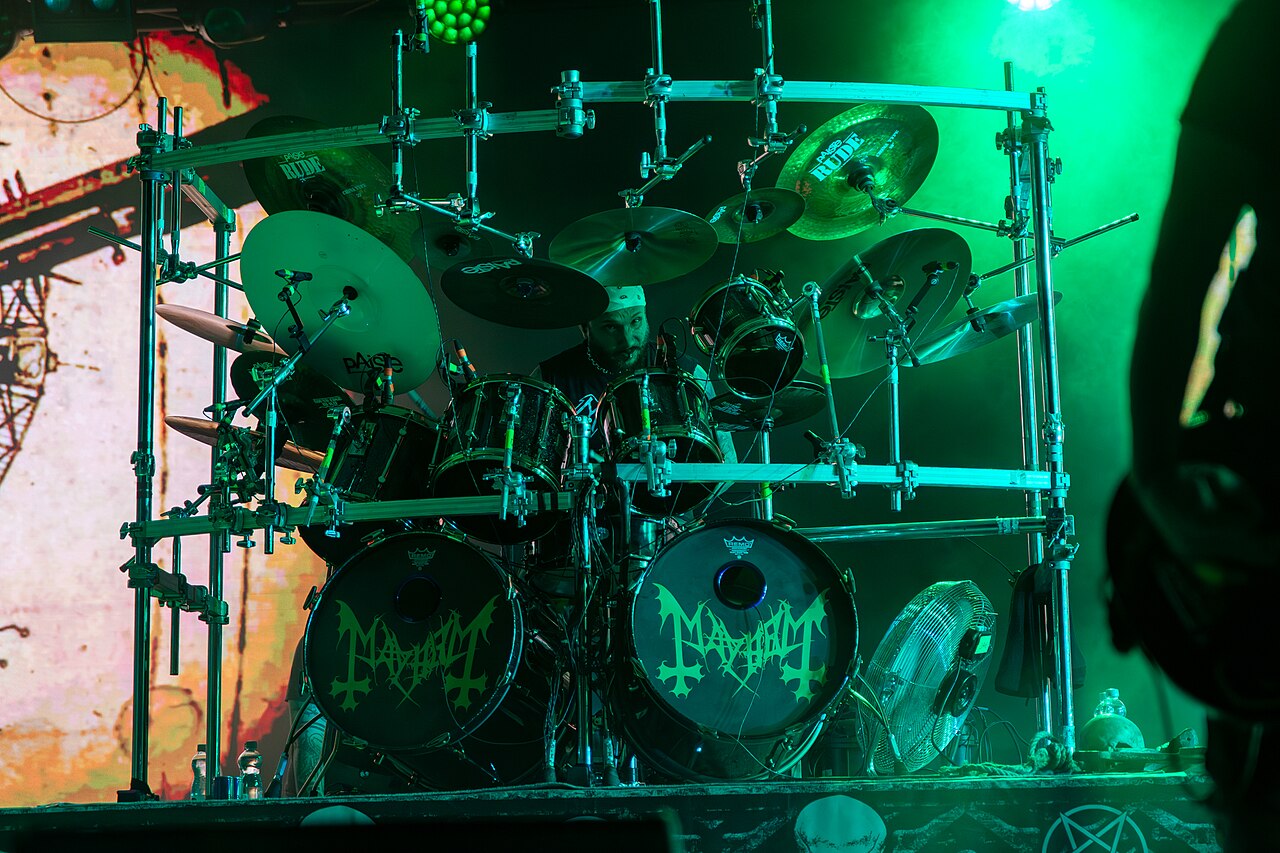
He grew up on a diet of football, wrestling, and synth-pop. Depeche Mode and Duran Duran were on heavy rotation, not the infernal noise of the Norwegian underground. The idea of sitting behind a drum kit initially held zero appeal. Yet Jan Axel Blomberg—born 2 August 1969 in Trysil, Norway—would eventually become Hellhammer, the rhythmic engine of Mayhem and a musician ranked by Loudwire as the 24th greatest metal drummer of all time. The path from New Wave obsession to black metal immortality was neither straight nor predictable. It was a slow-burning fascination that began with a jazz kit and a pair of generous grandparents.
The path from New Wave obsession to black metal immortality was neither straight nor predictable.
From jazz kit to extreme metal
The first three drum sets in his life were gifts from his grandmother and grandfather. The very first was a modest four-piece jazz configuration, a strange starting point for a future extreme metal icon. Blomberg didn't take formal lessons; he learned by playing along to his favorite records, absorbing the galloping precision of Iron Maiden, the raw aggression of Metallica, and the breakneck speed of Slayer. That method of reverse-engineering the music he loved forged a player who understood song structure intimately, not just blast beats. The foundations were being laid in a bedroom, far from the frozen forests of the black metal scene.
A seismic shift occurred when the darker, more primitive sounds of Venom and Celtic Frost entered his world. The raw, unpolished extremity of those bands rewired his musical brain. It was a direct line from that discovery to the adoption of his stage name. The moniker 'Hellhammer' was lifted directly from the pioneering Swiss extreme metal outfit, a signal of allegiance to the ugly, the abrasive, and the uncompromising. This wasn't just a nickname; it was a manifesto carved in leather and spikes, announcing the death of his pop sensibilities and the birth of something far more dangerous.
Joining Mayhem's chaos
By 1988, the transformation was complete. He joined Mayhem, the band that would become synonymous with black metal's most notorious chapter. It was a year of chaos and legend, and Hellhammer walked directly into the eye of the storm. He is the only musician to have played on every single one of the band's studio albums, a constant thread through suicide, murder, and constant reinvention. His drumming became the backbone of the genre's evolution, from the raw fury of 'De Mysteriis Dom Sanguinis' to the dissonant avant-garde explorations of later works. He wasn't just a timekeeper; he was a survivor.
Before the Mayhem legacy was cemented, another seed was planted. In 1987, alongside Steinar Sverd Johnsen and Marius Vold, he formed a band called Mortem. The name was a placeholder for something far stranger. The group morphed into Arcturus, a project that shattered the boundaries of black metal by injecting progressive and avant-garde elements. While Mayhem defined the orthodox sound of darkness, Arcturus dismantled it. Their work was theatrical, cosmic, and utterly unpredictable, showcasing a drummer capable of navigating complex time signatures and symphonic grandeur with equal ease.
Arcturus and beyond
The 2000s saw Arcturus rise as a cult phenomenon, only to disband in April 2007. The silence lasted for four years, a period where the project's legacy grew in its absence. Then, in 2011, the band reconvened, proving that their experimental spirit was not a finite resource. This pattern of dissolution and resurrection mirrors the chaotic career of Hellhammer himself. He never stayed in one lane. His work with Dimmu Borgir brought his precision-blasting to symphonic black metal's biggest stages, while his presence on records released via Century Media Records cemented his status as a reliable, world-class session musician.
His versatility attracted a wide range of artists, but it was his work with The Kovenant that brought institutional recognition. He won the Spellemannprisen—Norway's equivalent of the Grammy—twice with the band, both times for Best Hard Rock Album. That a drummer rooted in the underground extremity of Mayhem could hold a mainstream national award is a testament to his technical skill. The committee wasn't rewarding shock value; they were acknowledging a musician who had transcended the genre's insular walls. He has three of those awards in total, a surreal tally for a man who once played a four-piece jazz kit.
The genres attached to his name read like a map of extreme music's evolution: black metal, death metal, avant-garde metal, progressive metal. His early love for jazz eventually resurfaced, informing the fluidity and dynamics that set him apart from the metronomic machines of the scene. At 57 years old in 2026, he is a living archive of a sound he helped create. The wrestling mat and football pitch are long gone, replaced by a legacy of sessions and albums that define the cold, complex heartbeat of Norwegian metal.
The image lingers: a teenager in Trysil, headphones on, trying to match the thunder of 'Ride the Lightning' on a jazz kit bought by his grandparents. That gap between the soft, swinging instrument and the violent music it was forced to produce is the key to understanding Hellhammer. He didn't start with a double-bass inferno. He started with four pieces and a dream of chaos. The noise that followed was never just about speed; it was about a fan learning to play his favorite records, one imperfect, obsessive beat at a time.