
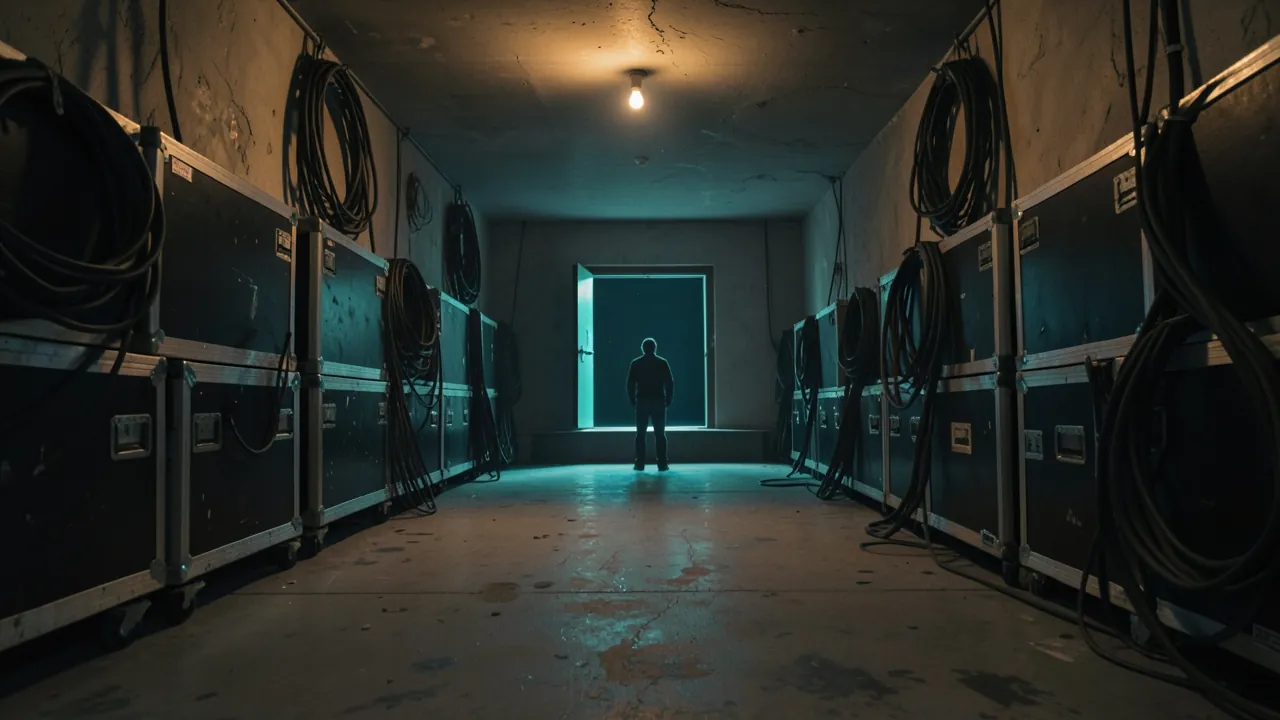
A crowd of roughly 15,000 packed into Seattle's Motor Sports International Garage on September 22, 1990, making it the largest Nirvana show to that point. Somewhere in that mass of bodies stood Dave Grohl, the drummer who would audition for the band just days later. The irony is sharp: the biggest room Nirvana had ever played was also the moment their future rhythm section first saw them from the floor. Grohl was not yet in the group, but the scale of the event hinted at what was coming.
Nirvana's name carried a weight the members may not have fully intended. The word traces back to a Sanskrit term meaning blowing out or extinguishing, a concept rooted in liberation from suffering and the cycle of rebirth. In Buddhist thought, nirvana marks the goal of the Noble Eightfold Path, described as the cooling of three fires: greed, hatred, and ignorance. The tradition distinguishes between nirvana with remainder and nirvana without remainder, the latter called parinirvana.
The word's meaning across traditions
The term did not stay confined to one tradition. In Hinduism, nirvana connects to moksha, the release of the soul, and the Bhagavad Gita uses the phrase brahma-nirvana. Jainism frames it as freedom from karmic bonds, while Sikhism also references it as a state of liberation. Some scholars argue that Hindus borrowed the word from Buddhists, since nirvana first appears in Buddhist texts, while the Vedas used the related concept of moksha. In Hindu thought, nirvana can mean the union of Atman with Brahman.
Buddhism adds another layer: nirvana is tied to emptiness, or shunyata, and the absence of a fixed self. That philosophical backdrop makes the band's choice of name feel less like teenage nihilism and more like a borrowed vocabulary of release. By the time Nirvana stood on that Seattle stage in 1990, the word had already traveled through centuries of doctrine. The garage setting, all concrete and exhaust fumes, was a long way from any monastery, but the crowd's energy suggested its own kind of transcendence.
The garage setting, all concrete and exhaust fumes, was a long way from any monastery, but the crowd's energy suggested its own kind of transcendence.
A milestone show before the audition
The show itself became a milestone in Nirvana's trajectory. Grohl's presence in the audience turned the event into an accidental audition preview, a live demonstration of the band's momentum before he ever sat behind the kit. The fact that his tryout came within days of this performance means the memory of that night was fresh when he joined. For a group still months away from mainstream breakthrough, the Motor Sports International Garage date proved they could command a festival-sized crowd.
That same year, Garth Brooks released No Fences, an album that entered the American chart and eventually became the best-selling country record in history. The contrast with Nirvana's raw garage show could hardly be starker: polished Nashville storytelling on one side, distorted Seattle noise on the other. Yet both were reshaping their corners of the music industry in 1990. The year sat at a pivot point, with alternative rock and country both finding audiences far larger than their traditional bases.
A landscape of strange collisions
The wider music landscape around that period was full of strange collisions. Bryan Adams spent 16 weeks at the top of the UK chart with a single from a Robin Hood film. Def Leppard lost a truck full of equipment in 1992 and had to cancel two shows. Diana Ross was arrested aboard Concorde in 1999 after an incident with a security guard. Cat Stevens, known as Yusuf Islam, was removed from a flight and deported from the United States in 2004 over suspected terrorist links.
Charity and legal battles also marked the era. Farm Aid began in 1985 in Champaign, Illinois, organized by Willie Nelson, John Mellencamp, and Neil Young after Bob Dylan's Live Aid appearance raised the question of American farmers. That first event drew around 80,000 people and generated more than nine million dollars. Decades later, in 2015, a federal judge ruled that the copyright on Happy Birthday was invalid, undoing a deal Warner/Chappell made in 1988 when it bought the rights for 15 million.
Back in Seattle, the September 22 show carried a quieter significance. Grohl watched from the crowd, the band played to its largest audience yet, and within days the lineup that would record the next chapter was complete. The name Nirvana, with all its Sanskrit and Buddhist weight, now belonged to a trio about to detonate. The garage is gone, but the date remains a hinge point: the moment before the drummer arrived, when the band's future stood anonymously in a crowd of 15,000.