
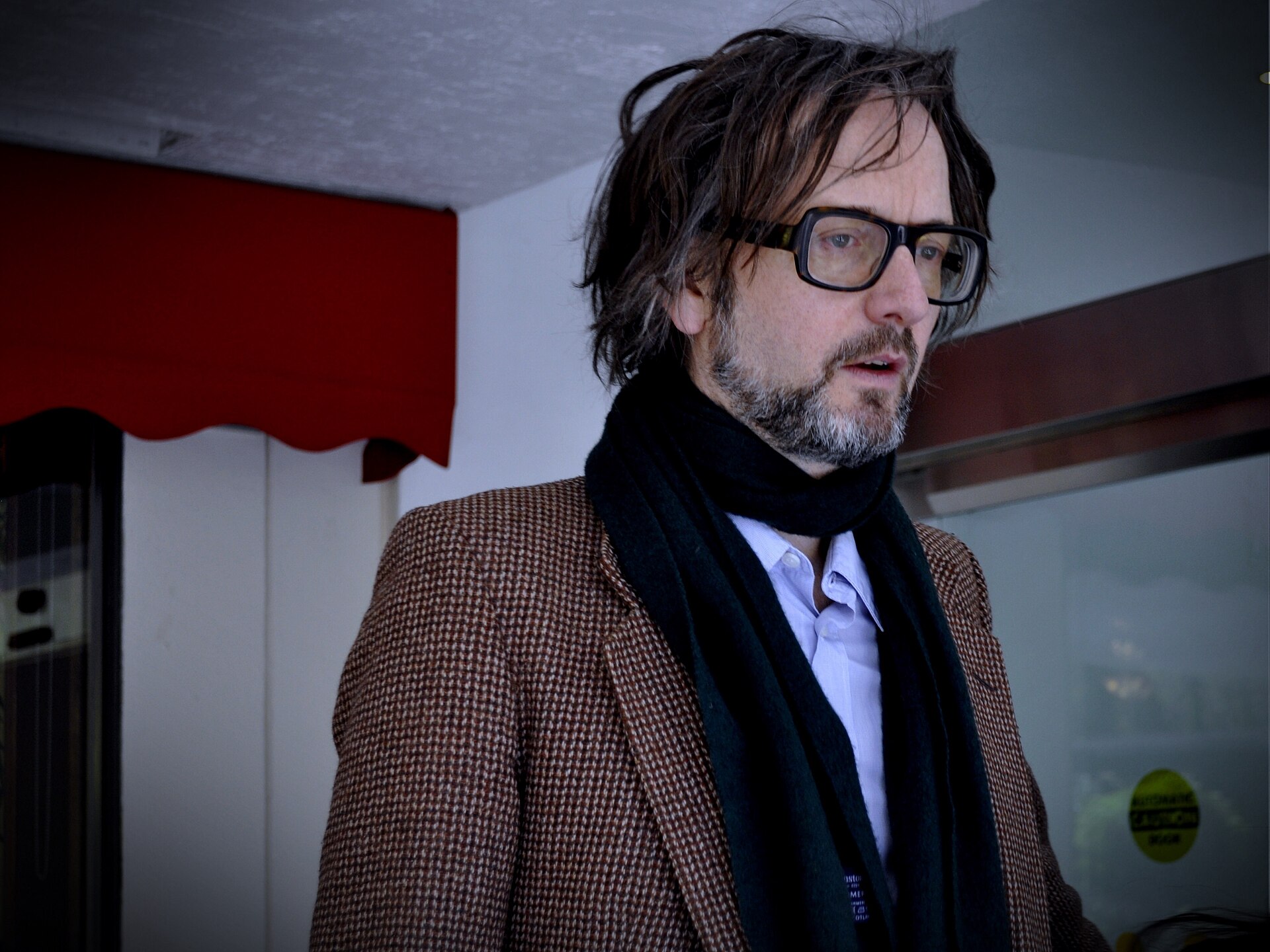
A butler wrote one of the sharpest pop records of the late 1990s. Jarvis Branson Cocker spent a stretch of his early life in that role, a detail that surfaces in his writing with the same deadpan precision he brought to songs about sex, class, and northern English boredom. Born on 19 September 1963 in Sheffield, he turns 63 in 2026, and the distance between that birthday and the bedsit dramas of Pulp feels less like nostalgia than a long-running argument about what pop music should be allowed to say.
Cocker founded Pulp and remained its only constant member across fifteen years of false starts, lineup changes, and eventual, improbable fame. He was the frontman, the lyricist, and the nervous system of a band that spent the 1980s failing in relative obscurity before the 1990s turned them into reluctant figureheads. When Britpop arrived, he became its involuntary leader, a lanky, spectacle-wearing presence who sang about kitchen sinks and council estates while other bands chased stadium choruses.
The absent father's radio voice
His father Mac Cocker was a DJ and actor who left the family when Jarvis was seven, moving to Sydney, Australia. For years there was no contact with Jarvis or his sister Saskia. Their mother Christine Connolly raised them alone in Sheffield, later becoming a conservative councillor, a political turn that added another layer to the family's contradictions. Mac Cocker spent the 1970s and 1980s as a radio DJ in Sydney on Double J, later Triple J, a voice his son never heard growing up.
The absence became material. On Pulp's 1998 album This Is Hardcore, the song "A Little Soul" addresses the father who left, written with a directness that avoids self-pity. That same year, Cocker and his sister traveled to Australia to meet Mac Cocker for the first time. Jarvis was around thirty. The reunion came after decades of silence, and the song had already been recorded, a letter sent before the addressee was known.
Sheffield's post-industrial influence
Cocker attended City School in Sheffield, and the city's post-industrial landscape shaped his early writing. By the mid-1990s, Pulp's albums turned everyday humiliation into anthems, and Cocker's lyrics carried a literary quality rare in alternative rock. He was never comfortable with the Britpop label, yet the movement needed his intelligence, and he wore the role of accidental spokesman with visible discomfort, always slightly outside the frame.
After Pulp went quiet, he built a solo career that kept his voice distinct. His debut solo album Jarvis arrived on 13 November 2006 and landed at 37 on the UK chart. Further Complications followed on 18 May 2009, reaching 19 in Britain and 155 in the United States. The singles tell their own story: "Running the World" came out as a download-only release on 21 August 2006, while "Don't Let Him Waste Your Time" hit 36 on the main chart and topped the indie chart on 8 January 2007. "Fat Children" managed 158 on 16 July 2007.
Collaborations and film work
Collaborations kept pulling him sideways. A live version of "Temptation" with Beth Ditto appeared as a standalone single on 18 February 2008, reaching 148. "Angela," lifted from Further Complications, was download-only from 17 April 2009. Later that year, a double A-side pairing "Further Complications." with "Girls Like It Too" arrived on 9 November. He also wrote songs for Wes Anderson's Fantastic Mr. Fox, adapting Roald Dahl's world with the same dry wit he brought to his own material.
Radio became another home. For seven years he hosted Jarvis Cocker's Sunday Service on BBC Radio 6 Music, a show built on deep cuts, odd juxtapositions, and his unmistakable speaking voice. He defended the station publicly when it faced threats, understanding its role in British music culture. In 2026 the programme returned to Radio 6 for a year-long run, putting Cocker back on air at 63 with the same curiosity that made the original broadcasts essential listening.
His solo work sits with Rough Trade Records, a label that suits his sensibility better than the major machinery of Island Records where Pulp spent their commercial peak. The official site remains jarviscocker.net, a modest digital outpost for a man who has spent four decades avoiding easy categories. Few artists could move from "A Little Soul" to a Sunday radio show without losing their edge, but Cocker's career has always thrived on the spaces between formats.
The butler's pantry, the absent father's radio voice in Sydney, the conservative mother in Sheffield, the indie chart number one, the return to BBC 6 Music in 2026. Cocker's life keeps refusing the clean arc. At 63, he is still the same figure who once turned a nightclub stage invasion into a piece of performance art, still writing about the world with the precision of someone who has seen the back rooms of both mansions and council flats.