
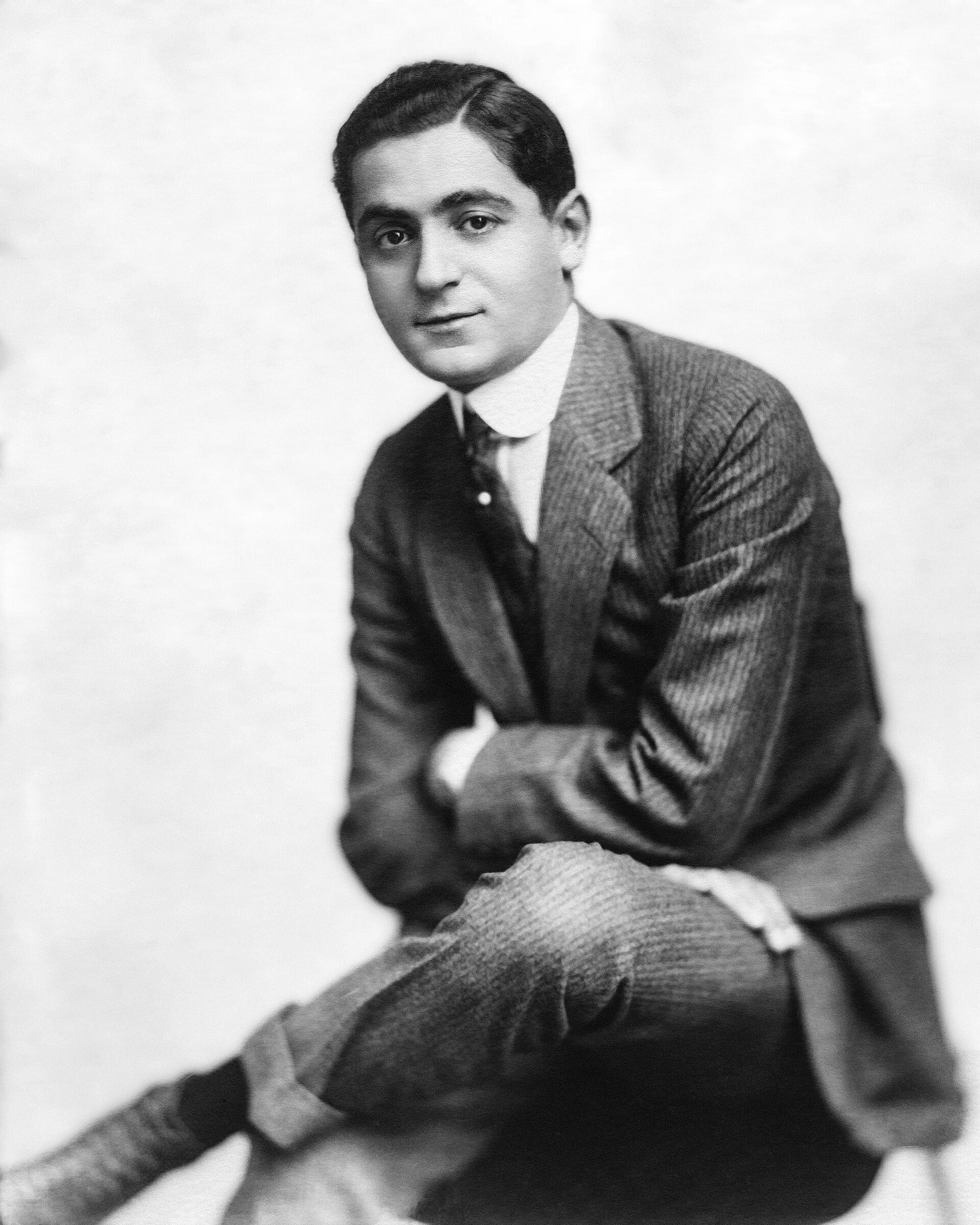
A composer who couldn't read sheet music and played in only one key somehow wrote the unofficial national anthem of the United States. Irving Berlin, born Israel Moiseevich Beilin in the Russian Empire, died in New York on September 22, 1989 — thirty-seven years ago this year. His catalog forms a huge portion of the Great American Songbook, yet the man behind 'God Bless America' spent decades giving conflicting answers about where he was born.
Conflicting accounts of origin
Berlin was the youngest of eight children in a Jewish family. His father, Moses Beilin, worked as a synagogue cantor, and both parents came from the town of Tolochin. Shortly after Irving's birth on May 11, 1888, the family moved to Tobolsk. In interviews during the 1930s and 1940s, Berlin claimed he was born in Mogilev. Decades later, when Steven Spielberg planned a film about him in the 1980s, Berlin told the director he was from Tobolsk.
The family left Russia when Irving was five years old, fleeing pogroms against the Jewish shtetl of Tolochin. One older brother stayed behind in Tolochin after the emigration. The Beilins arrived in the United States with almost nothing. Berlin's first published song, 'Marie from Sunny Italy,' came out in 1907 — one hundred nineteen years ago — and he sold the rights for thirty-three cents.
From vaudeville to Broadway fame
Four years after that first song, Berlin wrote 'Alexander's Ragtime Band' in 1911. The hit made him a star in vaudeville and musical theater. He became a Broadway fixture and eventually owned the Music Box Theatre. Berlin worked as a songwriter for stage productions and films, collaborating with Columbia Records and winning an Oscar, a Grammy, and a Tony across his career.
Berlin's musical limitations were extreme. He could not read sheet music for most of his career and played piano only in the key of F-sharp. To work in other keys, he used a special piano with a transposing lever. This mechanical workaround let him compose melodies that sounded effortless. Journalist Walter Cronkite once said Berlin 'helped write the history of this country.'
Journalist Walter Cronkite once said Berlin 'helped write the history of this country.'
The unresolved birthplace question
The composer's origin story kept shifting. Tyumen-based websites claim Berlin was born in Tyumen, while his own interviews named Mogilev and Tobolsk at different times. The documented record points to Tolochin as his parents' hometown, but Berlin's birth certificate has never settled the debate. Spielberg's planned film never got made, leaving the question of Berlin's birthplace open.
Berlin's songs became American standards. 'God Bless America' is considered an unofficial national anthem, and his work spans musical play and vaudeville genres. He received the Presidential Medal of Freedom from Gerald Ford in 1977 — forty-nine years ago. The composer's output for Broadway and Hollywood made him one of the most performed songwriters of the twentieth century.
His death in 1989 at age one hundred one closed a career that began in Tin Pan Alley and ended with a Grammy lifetime achievement. Berlin's catalog includes hundreds of songs, many still performed today. The man who could not read music left behind melodies that generations of Americans learned by heart.
The transposing piano Berlin used sat in his office for years, a silent witness to how a limited pianist wrote in every key. That instrument — not a trophy or a plaque — explains the paradox. A boy from a Russian shtetl, fleeing pogroms, became the voice of American optimism without ever learning to read the notes he wrote.