
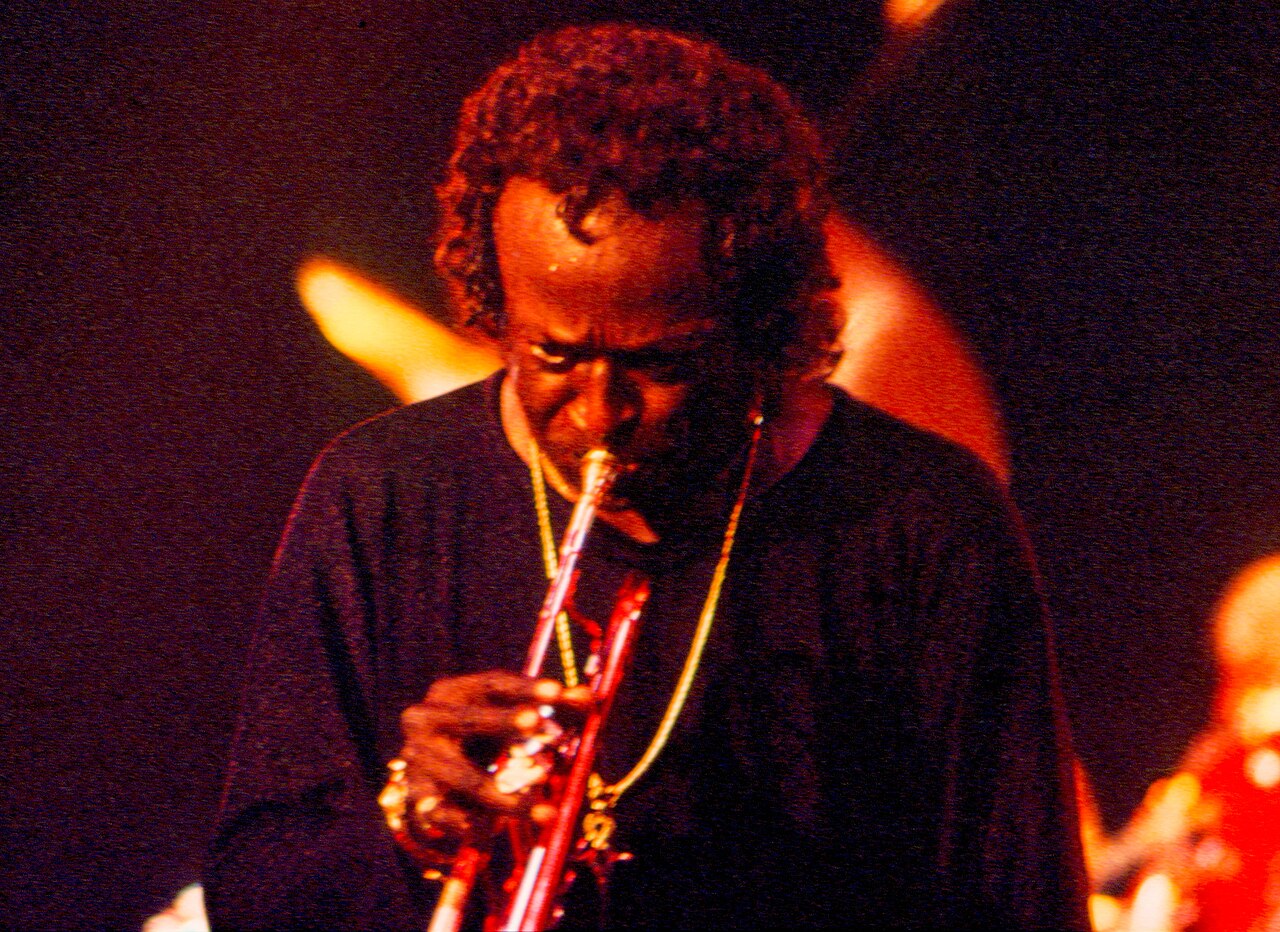
A teenager from East St. Louis walks into the most prestigious music school in New York and walks out into a jam session on 52nd Street. Miles Davis enrolled at Juilliard in 1945, intending to become an academic performer, then abandoned that path almost immediately. The contradiction defined him: formal training and street-level bebop pulling in opposite directions, with the street winning.
Miles Davis died on September 28, 1991 in Santa Monica. Thirty-five years later, in 2026, the arc of his career still reads like a map of jazz itself. Born May 26, 1926 in Alton, Illinois, he grew up in East St. Louis in a family of considerable means. He picked up the trumpet at 13, and by his late teens the instrument had already decided his future.
The real education on 52nd Street
The Juilliard detour lasted barely a breath. Davis spent 1944 to 1948 playing alongside Charlie Parker, debuting professionally in Parker's bebop quintet. Those years on 52nd Street, not the conservatory classrooms, became his real education. He quit Juilliard and never looked back, though the technical grounding stayed with him for decades.
Davis was never confined to one jazz style. He stood at the origins of bebop, then helped shape cool jazz through the Birth of the Cool sessions for Capitol Records. In the early 1950s he recorded some of the first hard bop compositions for Prestige Records. Later came modal jazz and, eventually, jazz fusion. Each shift wasn't a reinvention so much as a refusal to stay put.
Birth of the Cool pivot
The Birth of the Cool sessions remain a pivot point. Those Capitol Records dates gave cool jazz a vocabulary it hadn't possessed before. Davis the arranger, Davis the bandleader, Davis the composer for film scores — all of those roles surfaced early. Duke Ellington compared him to Picasso, a musician who could redraw the canvas whenever the old forms stopped breathing.
After returning to the Newport Jazz Festival, Davis signed a long-term contract with Columbia Records. He had already worked with ensembles led by Sonny Stitt and Clark Terry. The Columbia years would produce the recordings that carried his influence into rock, funk, classical music, and eventually hip-hop. Three generations of listeners heard jazz through the sound he defined.
A career without clean breaks
The range is staggering when you line it up. From bebop in the 1940s to experimental directions decades later, Davis's recordings trace the evolution of jazz without a single clean break. He was among the most influential figures in jazz history, an American trumpeter whose reach extended far beyond the bandstand. ACT Music, among other labels, would later carry his work to new audiences.
What gets lost in the discography talk is the painter. Davis was also an artist in the visual sense, working with color and form the way he worked with intervals and silence. The same instinct for negative space that made his trumpet lines so sharp shows up on canvas. His career spanned nearly five decades, but the creative restlessness never settled into a style.
He began playing trumpet in his early teens, and by 1945 he was already recognized as a jazzman of consequence. The Juilliard classrooms couldn't hold him. The jam sessions on 52nd Street could. That choice, made when he was barely out of his teens, set the terms for everything that followed.
In 1991 the trumpet went silent in Santa Monica. But the sound he shaped in those 52nd Street sessions — taut, spare, unafraid of empty space — still cuts through the noise. A hundred years after his birth in Alton, the silence between his notes remains as loud as any horn line ever played.