
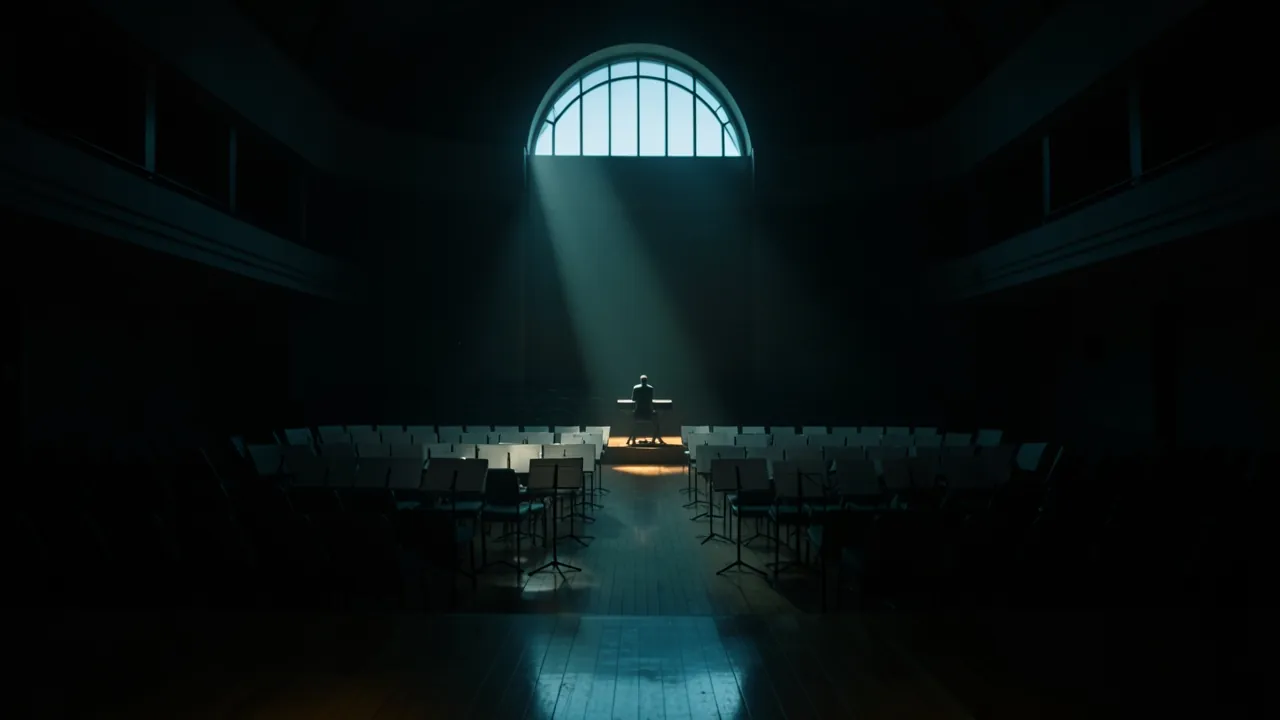
A Roland Juno-60 sits next to a grand piano in a Berlin studio, cables trailing between them like unfinished thoughts. The man moving between the instruments is Nils Frahm, born 20 September 1982, and today he turns 44. Few musicians treat a synthesizer and a concert instrument as extensions of the same nervous system, but Frahm has spent decades proving the boundary is thinner than most listeners assume.
ECM aesthetics and early study
Frahm grew up near Hamburg, where his father Klaus Frahm worked as a photographer. The elder Frahm shot covers for ECM Records, which meant the household absorbed a particular visual language of restraint and negative space. That aesthetic seeped into the son's ears early. As a child, Nils Frahm studied works by classical and modern composers, absorbing structure and silence before he ever touched a mixing console.
The console came at school, where Frahm began working with mixing desks while his classmates were still deciding what music meant to them. He cared about recorded sound quality long before streaming made such concerns seem quaint. Eight years of classical piano study under Naum Brodsky gave him technical discipline, but the school consoles gave him something rarer: an engineer's obsession with how sound behaves before and after it reaches a microphone.
Berlin studio gear and technique
By 2006, Frahm had moved to Berlin and started working as a technician. The city's studio culture put him in rooms with gear most pianists never touch. His instrument list eventually included the Roland Juno-60, a Rhodes piano, drum machines, and a Moog Taurus analog synthesizer alongside the grand and upright pianos. Each machine shaped his hands differently, and his compositions began to reflect that physical negotiation.
Frahm's approach to keyboards is deliberately unusual. He treats hammers, felt, and electronic oscillators as equal partners rather than separate worlds. The result sits somewhere between classical music, electronic music, ambient music, and contemporary classical music without settling comfortably in any category. Collaborations with Anne Müller, Ólafur Arnalds, F. S. Blumm, and Woodkid pulled that hybrid sound into other vocabularies entirely.
Early solo recordings and Nonkeen
In 2009, two early solo works appeared: Wintermusik and The Bells. These recordings established the quiet intensity that would define his catalog. They also demonstrated how much of Frahm's sound comes from decisions made before a note is played: microphone placement, room tone, the creak of piano wood. Listeners heard a musician who considered the recording itself part of the composition.
Listeners heard a musician who considered the recording itself part of the composition.
Frahm also records and performs as Nonkeen with Frederic Gmeiner and Sebastian Singwald. That trio channels a looser, more rhythmic energy, proof that Frahm's Berlin life as a technician and collaborator feeds his solo identity rather than competing with it. The project remains a vital outlet for ideas too kinetic for his piano-centered work.
Seventeen years after those first solo releases, Frahm's catalog spans intimate piano meditations and dense electronic constructions. His label home, Erased Tapes, has given that range a coherent visual and sonic identity. Twenty years after arriving in Berlin, he remains a technician at heart, still drawn to how a room shapes a chord and how a synthesizer can breathe like an acoustic instrument.
The Juno-60 in his studio still sits within arm's reach of the grand piano. That arrangement is not a statement; it is simply how Nils Frahm works. Nine years of formal study, eight with Brodsky, school consoles, ECM cover art, Berlin's studios: every element converged into a musician for whom the distance between a felt hammer and a voltage-controlled filter is just a patch cable.