
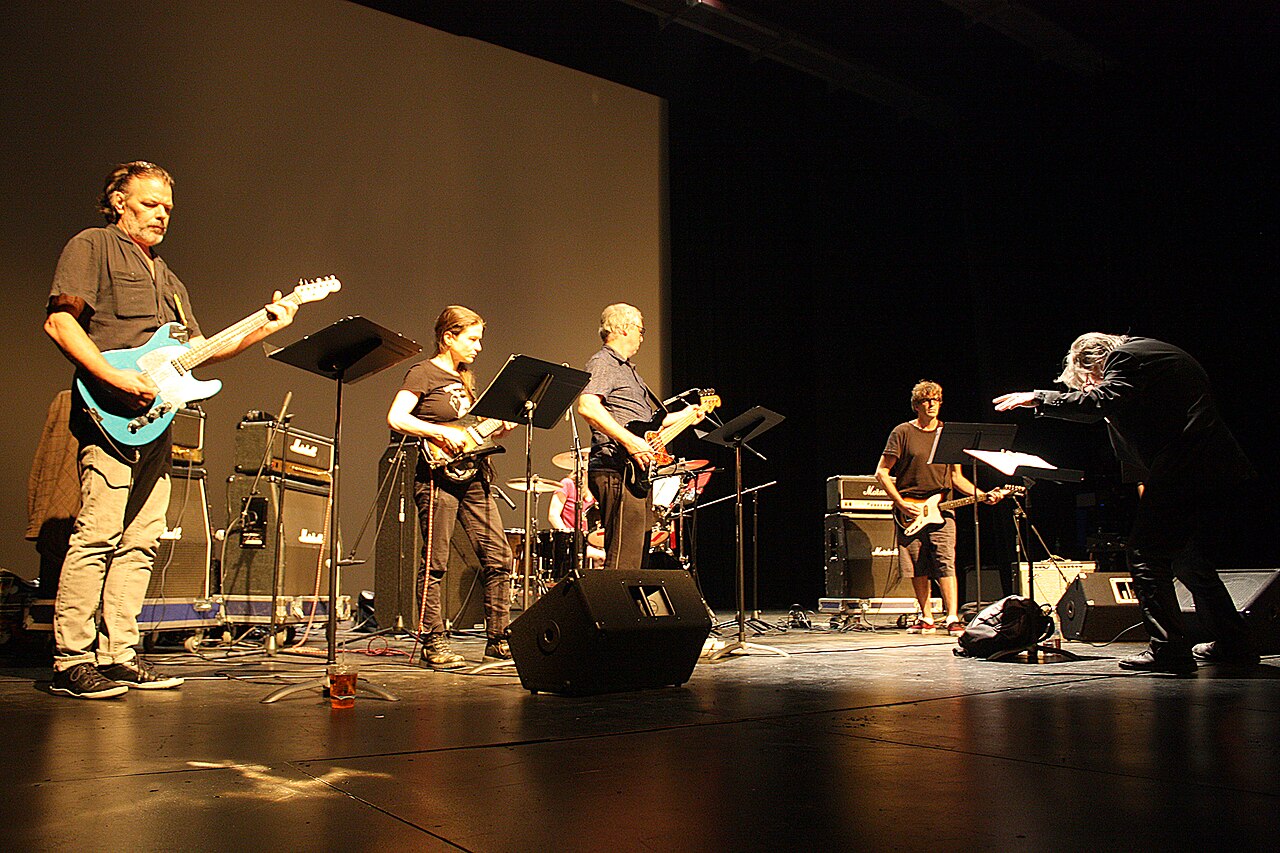
On a summer evening in New York, a hundred electric guitars faced the World Trade Center. The American avant-garde composer Glenn Branca stood before them, leading a sound so massive it seemed to shake the plaza. This was his Symphony No. 13, performed on June 13, 2001, less than three months before the towers fell. Branca had spent decades building toward this moment, crafting instruments and music that redefined what a guitar could do. He was born on October 6, 1948.
From Harrisburg to the Bastard Theatre
Branca was born in Harrisburg, Pennsylvania, on October 6, 1948. He picked up the guitar at fifteen and, as a teenager, made sound collages on tape. In the summer of 1967 he formed a cover band called The Crystal Ship, but his ambitions quickly outgrew pop songs. By the early 1970s he was studying theater in Boston, and in 1975 he founded an experimental troupe, Bastard Theatre, in a loft on Massachusetts Avenue. The group staged original music-theater works with live musicians, and Branca wrote much of the music.
In 1976 Branca moved to New York to continue experimental theater. The city's downtown scene was exploding with raw, dissonant bands. Branca soon formed his own group, Theoretical Girls, recruiting members through flyers he posted around the city. The band became a fixture of the no wave movement, a short-lived but influential burst of abrasive rock. Yet Branca was already thinking beyond clubs and rock songs.
Harmonic guitars and The Ascension
By the early 1980s, Branca had released his first solo album, Lesson No. 1, and in 1981 he composed The Ascension for an ensemble of electric guitars. The piece built towering walls of sound from simple harmonic intervals. He also began building his own instruments, including 'harmonic guitars'—zither-like creations with a third bridge that produced ringing overtones. These instruments let him control the music's harmonic spectrum with precision.
Branca's Symphony No. 3, written in 1983, marked a turning point. He began composing systematically from the harmonic series, the natural sequence of overtones that underlies all musical pitch. This approach gave his music a strange, almost physical power. He assembled ensembles of guitarists, including Thurston Moore and Lee Ranaldo of Sonic Youth, and later Page Hamilton of Helmet. The music was loud, but it was not noise: it was architecture built from pure vibration.
The music was loud, but it was not noise: it was architecture built from pure vibration.
The 100-guitar piece became Branca's signature. After the World Trade Center performance, the work was staged in cities across the United States and Europe. Each performance required a small army of guitarists, all playing in precise synchronization. Branca conducted them like a general, shaping the massive sound with small gestures. The effect was overwhelming—a wall of overtones that seemed to bend the air itself.
Branca died in New York on May 13, 2018, at the age of 69. His wife, Reg Bloor, announced the news on Facebook the next day. He left behind a body of work that had pushed the electric guitar far beyond its rock-and-roll roots. The 100-guitar symphony remains a testament to his vision: a single instrument multiplied into an orchestra, a sound so large it could fill a city plaza and linger in memory long after the last chord faded.