
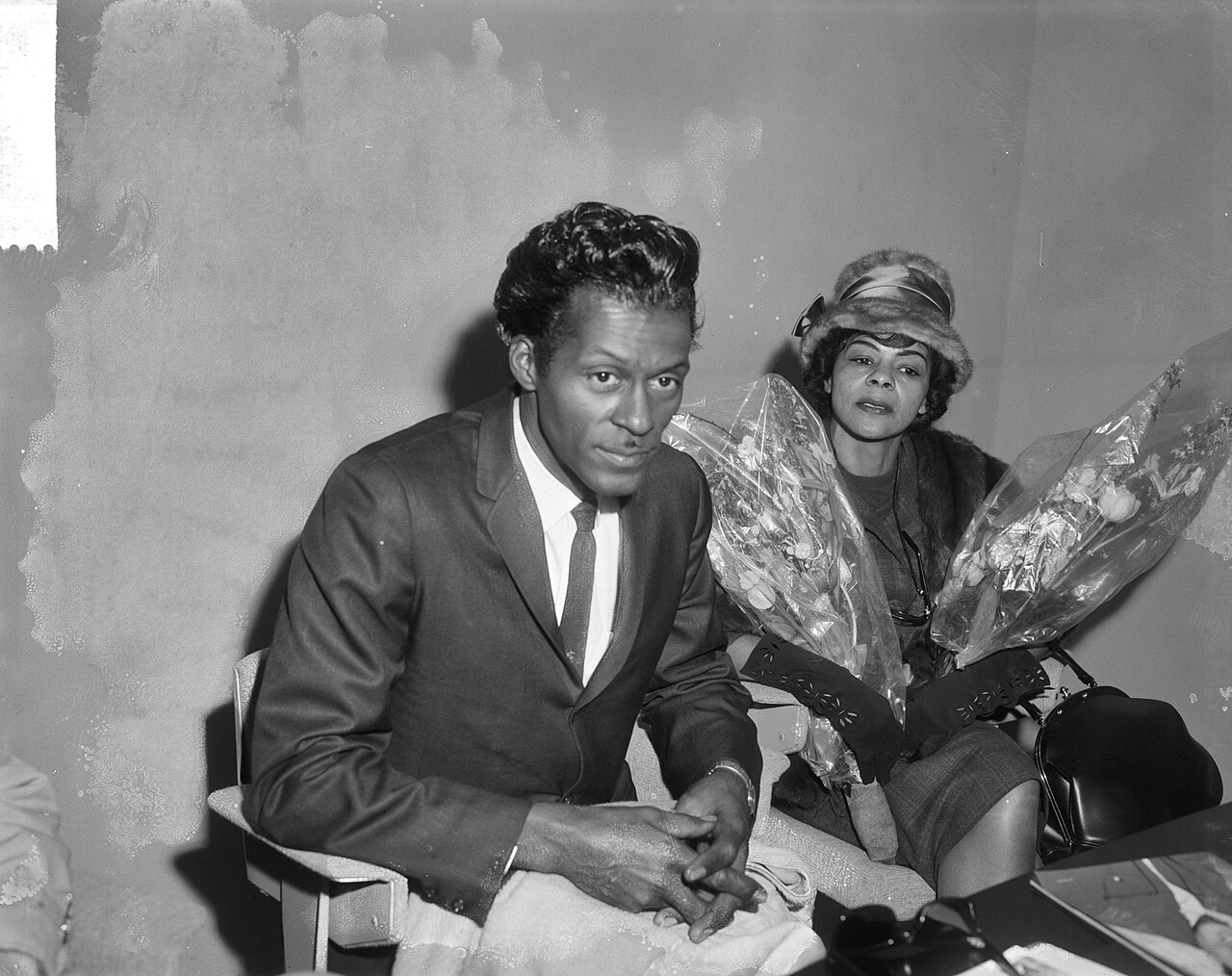
At twenty-one, Chuck Berry walked out of a Missouri reformatory a free man. Four years later, he walked into a Chicago recording studio and cut a song that would sell over a million copies. The distance between those two moments is the story of how rock and roll got its first great songwriter. Chuck Berry was born on October 18, 1926.
From St. Louis to Jefferson City
Berry was born in St. Louis on October 18, 1926, the youngest child of a Baptist deacon and a school principal. His first public performance came at Sumner High School in 1941, but the promise of that stage was cut short. At eighteen, he was arrested for armed robbery of three stores and sent to a reformatory for young men in Jefferson City.
Inside, Berry did not disappear. He formed a vocal quartet that performed outside the walls and trained as a boxer. Released on his twenty-first birthday, he returned to St. Louis with a musician's instincts and a survivor's discipline. By the early 1950s, he was playing local clubs, borrowing guitar licks from bluesman T-Bone Walker and taking lessons from jazz guitarist Ira Harris. In 1948, Berry married Themetta 'Toddy' Suggs, and two years later they welcomed a daughter, Darlin Ingrid. By early 1953, he was performing with Johnnie Johnson's trio, a partnership that would shape his early sound.
The Chicago Breakthrough
The break came in May 1955 when Berry traveled to Chicago and met Muddy Waters, who told him to see Leonard Chess at Chess Records. Berry recorded 'Maybellene,' a reworking of the country song 'Ida Red,' with a band that included pianist Johnnie Johnson and bassist Willie Dixon. The single topped the Billboard rhythm-and-blues chart and sold more than a million copies.
The song's authorship was messy at first: two other names, including disc jockey Alan Freed, were listed as co-writers. Berry fought and eventually regained full rights to 'Maybellene.' 'Roll Over Beethoven' reached number 29 on the Billboard Top 100, and Berry appeared in the film Rock Rock Rock performing 'You Can't Catch Me.'
Prison, Comeback and British Champions
Then the ground shifted again. After an arrest under the Mann Act and a conviction, Berry spent February 1962 to October 1963 in prison. When he came out, British bands like The Beatles and The Rolling Stones were championing his songs. He released eight singles, three of them top-20 hits, including 'No Particular Place to Go' and 'You Never Can Tell.'
The comeback had a strange coda. A live recording of the novelty song 'My Ding-a-Ling' became Berry's only number-one single. It was a joke that topped the charts, but it proved that the man who wrote 'Maybellene' and 'Johnny B. Goode' could still command an audience. Berry's influence reached beyond music. In 1979, he performed at the White House at the request of President Jimmy Carter. That same year, he pleaded guilty to failing to pay nearly $110,000 in federal income taxes and was sentenced to 120 days in prison.
Chuck Berry died at ninety. He left behind a body of work that defined the language of rock and roll, but the sharpest turn in his life was not a chord change. It was the walk from a reformatory gate to a recording studio, from a twenty-one-year-old with a record to a twenty-eight-year-old with a hit.
It was the walk from a reformatory gate to a recording studio, from a twenty-one-year-old with a record to a twenty-eight-year-old with a hit.