
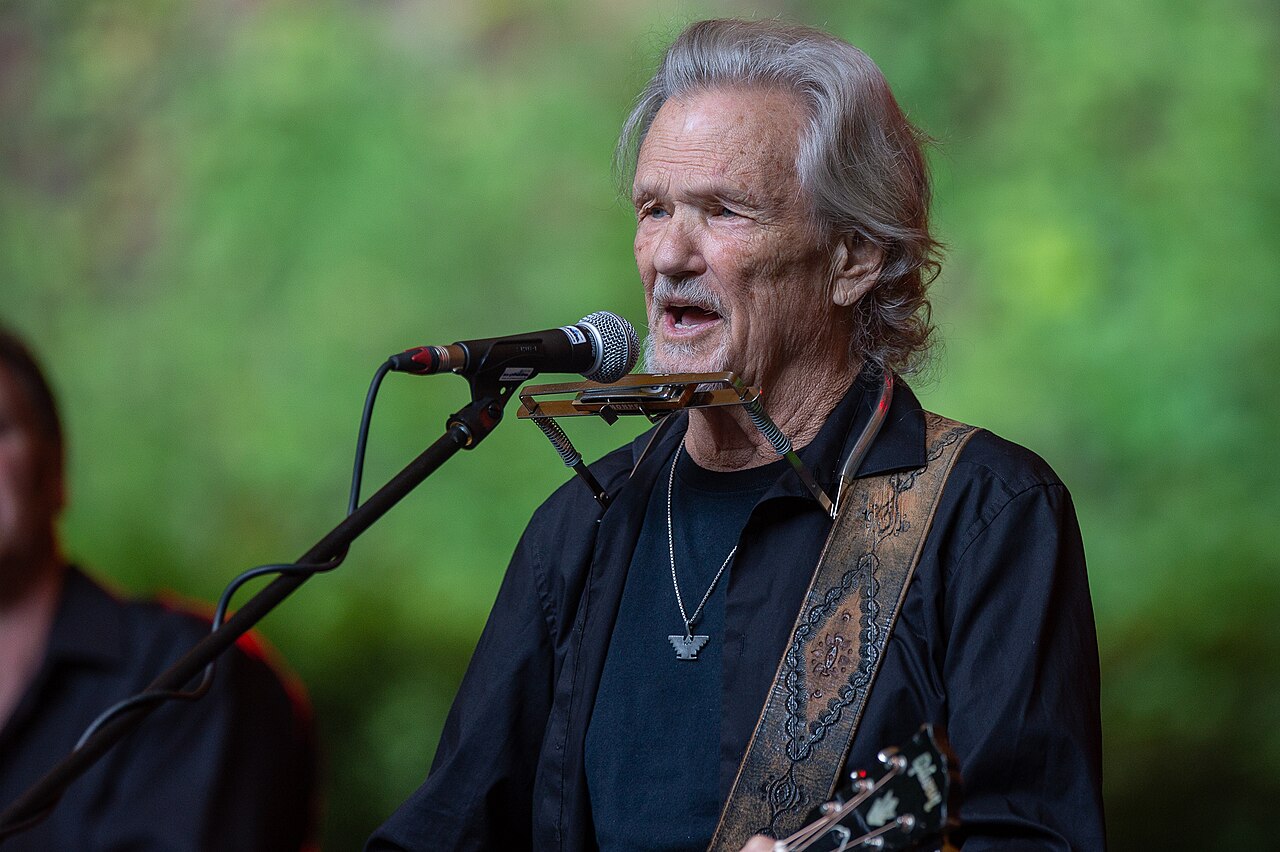
A young Army captain steps off a helicopter in West Germany, walks into a barracks, and decides he's done. Kris Kristofferson had flown choppers for the American military and reached the rank of captain, yet the world waiting for him had nothing to do with orders or rank. He was about to trade one uniform for another — the one worn by a songwriter chasing something raw and personal.
Christopher Kristofferson was born on June 22, 1936 in Brownsville, Texas. His father, Lars Henry Kristofferson, served as an officer in the Army Air Corps and later became a major general in the US Air Force. His paternal grandfather had been an officer in the Swedish army. His mother, Mary Ann, came from a German family with Frisian roots. The military lineage surrounded him on all sides.
From military service to songwriting
The family moved to San Mateo, California when he was a child. By the early 1960s, Kristofferson had entered military service himself, flying helicopters in West Germany. He was discharged in 1965 at the rank of captain. That moment of walking away from a defined path would echo through everything he wrote later — songs about drifters, losers, and people choosing freedom over safety.
When he returned to the United States in 1968, Kristofferson heard Bob Dylan and something shifted. He began writing songs that rejected the polished Nashville formula. Instead of cowboy clichés and romantic fantasies, he pushed country music toward deeper personal expression. This was the beginning of what would become the outlaw country movement of the 1970s, and Kristofferson was one of its pioneers.
Confessional songs that broke the mold
His songs read like confessions. 'For the Good Times' came in 1968, 'Sunday Mornin' Comin' Down' in 1969. Then, in 1970, two more: 'Me and Bobby McGee' and 'Help Me Make It Through the Night.' These were not novelty numbers or sentimental filler. They were bruised, introspective, delivered in a voice that sounded like it had been through something.
They were bruised, introspective, delivered in a voice that sounded like it had been through something.
Artists around him took notice. Kristofferson wrote songs for Jerry Lee Lewis, Johnny Cash, and Janis Joplin. It was Joplin's version of 'Me and Bobby McGee' that became her most famous hit — a posthumous number one that sealed the song's place in rock and country history. The songwriter had become one of the most covered voices of his generation.
A changing roster of labels
In 1969, Monument Records signed him after just one single on Epic Records. Kristofferson would record 10 albums for Monument, then two for Mercury Records, one each for Justice Records and Atlantic Records, and two apiece for New West Records and KK Records. The labels kept changing, but the approach never did: spare arrangements, direct language, no costume.
Hollywood came calling in 1971 when he debuted in the film 'The Last Movie.' By the late 1970s, Kristofferson was spending much of his time on movie sets, often working with director Sam Peckinpah. He moved between soundstages and songwriting sessions without ever losing the rough edge that defined both sides of his public life. His Grammy wins came in 1972, 1974, and 1975.
The Country Music Hall of Fame admitted him in 2004. Kristofferson died on September 28, 2024 on Maui, Hawaii, two years ago this autumn. The soldier's son from Brownsville, Texas left behind songs that had already changed what a country record could sound like. In 1971, he recorded an album amid the American bard movement — a fitting final chapter for a career built on saying the unsayable.
That same year — 1971 — the former Army captain who once flew helicopters over West Germany stood on a film set, his first movie role in front of cameras. It was a long way from the barracks. But the distance between the military discipline he left in 1965 and the unpolished honesty of 'Sunday Mornin' Comin' Down' was exactly the space where outlaw country lived.