
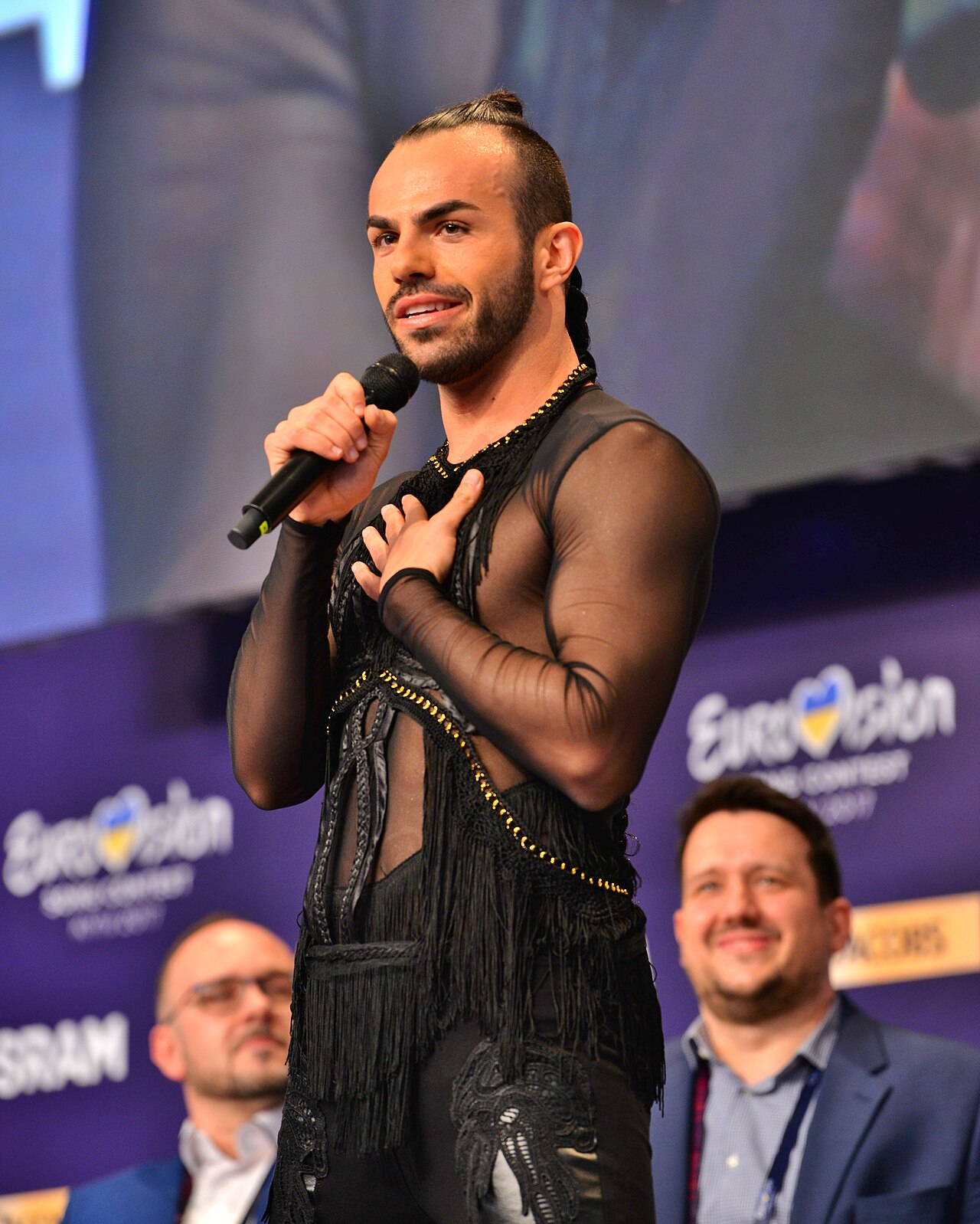
On a spring night in Kyiv, Montenegrin singer Slavko Kalezić stood in the wings of the Eurovision Song Contest, waiting to perform a song called “Space.” He was 31 years old, a trained actor and a soul-influenced pop singer from Podgorica, and he was about to become one of the most talked-about contestants of the year—though not for the reason he hoped. He was born on October 4, 1985.
The song had been written by a Swedish team and produced in Stockholm, a slick, confident pop track built to survive the contest’s first semifinal. But when the votes came in, “Space” landed in 16th place with 56 points, nowhere near the final. The same season, he won the Barbara Dex Award for the worst outfit—a prize given to the contestant whose stage look missed the mark. For most artists, that would be the end of the story.
From Cetinje to the Eurovision stage
Kalezić had spent years building toward that moment. Born in Titograd, now Podgorica, he trained at the Academy of Dramatic Arts in Cetinje, joined the Montenegrin National Theatre ensemble, and released his first single “Muza” in 2011. By the time he auditioned for the first season of X Factor Adria in Podgorica, singing Beyoncé’s “End of Time,” he was already a working actor with a clear voice and a taste for drama. He made it to the judges’ houses stage, mentored by Željko Joksimović in the Over 27s category, but missed the live shows.
The Eurovision failure could have been a full stop. Instead, it became a hinge. A few months after Kyiv, Kalezić walked into an audition room for The X Factor UK. He told the judges that Louis Walsh, who had been in the Irish delegation in Kyiv, had suggested he try the British show. He got three yeses, then moved through bootcamp with Rihanna’s “Where Have You Been,” survived the six-chair challenge with “Little Bad Girl,” and reached judges’ houses—only to be cut by Nicole Scherzinger after “On the Floor.”
Rejections that raised his profile
Twice in one year, the big television door had opened and then closed. But the rejections had a strange side effect: they made him more visible than winning might have. He was invited to perform at World Pride in Madrid, sharing a stage with Loreen and Conchita Wurst at the Puerta de Alcalá. He became the first Eurovision artist to appear at the Australian preview parties in Sydney and Melbourne. He kept releasing music—pop, R&B, soul—and kept saying yes to stages that would have him.
The next spring, he published “Moja Istina,” a book in Montenegrin about his Eurovision and X Factor year, with plans for an English translation. A year after that, he turned the book into a one-off multimedia show at the Ramada hotel in Podgorica, telling the story himself. The title meant “My Truth,” and that was the point: he had stopped auditioning for a slot and started building a persona.
A permanent place in Eurovision spaces
By 2019 he was still showing up in Eurovision spaces—invited by OGAE Israel to play Eurofan Café during semifinal week, staying for the grand final to support the contestants. The competition that once rejected him had become a circuit he could work. The flop in Kyiv had not ended his career; it had given him a story to tell, and he told it in four languages, on Pride stages, in clubs, and in a book.
Slavko Kalezić never made a Eurovision final. He never made the live shows of X Factor Adria or the UK version. But the man who once sang “Space” from a stage in Kyiv turned every closed door into a dressing room mirror. He looked at the rejection, adjusted the outfit, and walked back out.
But the man who once sang “Space” from a stage in Kyiv turned every closed door into a dressing room mirror.
He is still active in music, still writing and performing pop, R&B, and soul. The actor from Podgorica who once played a fake prostitute in a film and a vampire in a local comedy now headlines Pride galas and Eurovision fan events. The worst-dressed award hangs in his past like a costume he chose to keep wearing.