
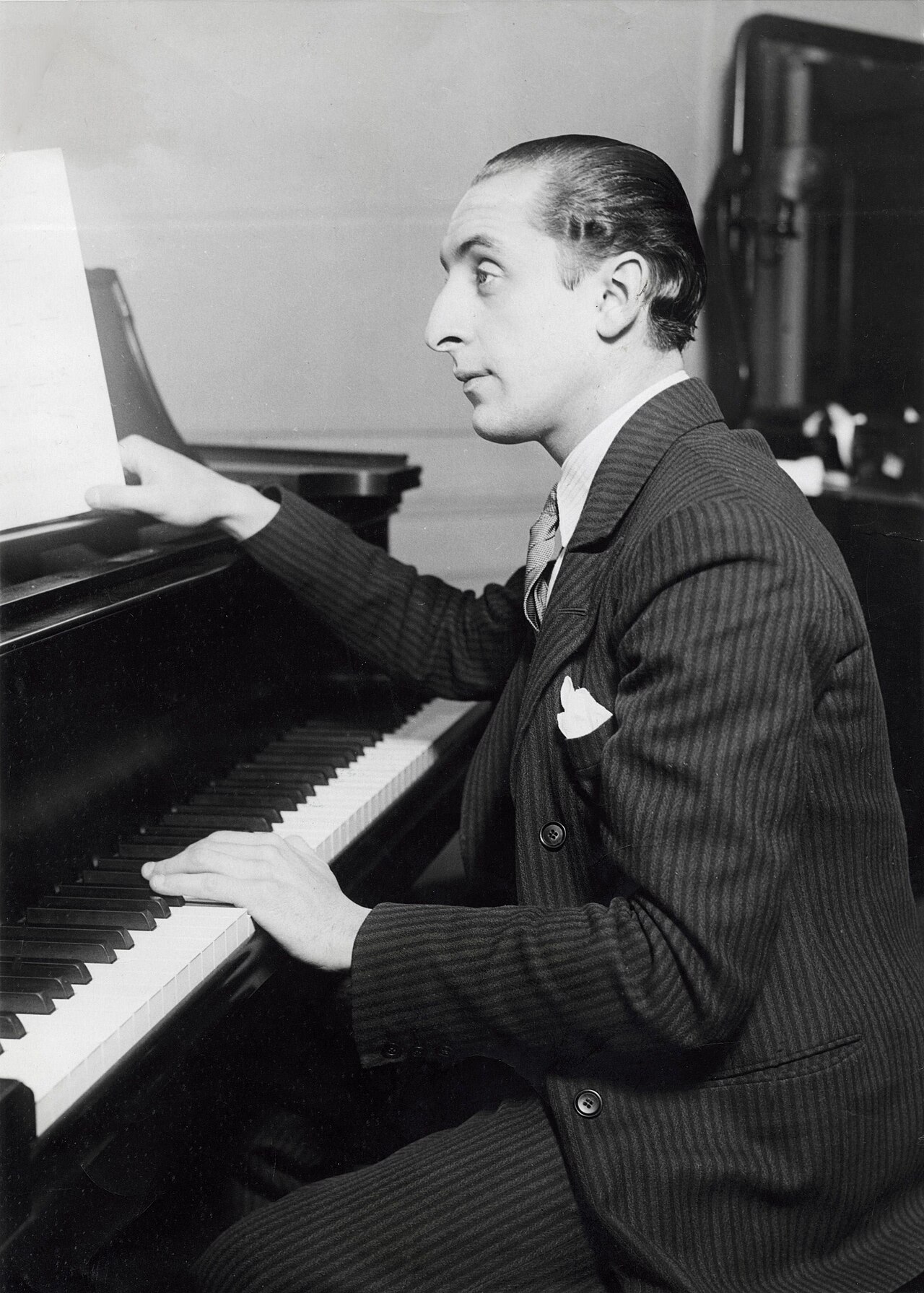
Vladimir Horowitz was born in Kyiv on 1 October 1903, the youngest of four children in the family of Samuil and Sophia Horowitz. His mother was a pianist and gave him his first piano lessons. A birth certificate names Kyiv as the place of birth, though one account has suggested Berdichev instead. The family's musical connections ran deep: his uncle Alexander had studied with the composer Alexander Scriabin and was close to him. When Horowitz was 10, he played for Scriabin, who thought highly of the boy's talent.
Kyiv training and early recitals
Horowitz entered the Kyiv music school in 1912; a year later it became a conservatory. His teachers there included Vladimir Puchalsky, Sergei Tarnowsky and Felix Blumenfeld. His first solo recital took place in Kyiv on 30 May 1920. He finished the conservatory that same year but never received a diploma, because he lacked a secondary-school certificate. Early in his career in Soviet Russia he was often paid in bread, butter and chocolate rather than money.
The scale of his early workload was startling. In the 1922–1923 season Horowitz gave 23 concerts with eleven different programmes in Petrograd. Between November 1924 and January 1925 in Leningrad he performed more than 155 works across 20 concerts. Horowitz himself said he had wanted to be a composer, and turned to the piano to support his family after the revolution. In December 1925 he left for Germany, officially to study with Artur Schnabel, though he had no intention of coming back. Before leaving he learned and played Tchaikovsky's First Piano Concerto in Leningrad.
In the 1922–1923 season Horowitz gave 23 concerts with eleven different programmes in Petrograd.
First concerts outside the USSR
His first concert outside the USSR came on 18 December 1925 in Berlin. A 1926 debut at the Beethovenhalle left the Berlin audience cold, put off by the intensity of his playing. In Hamburg he stepped in for an ill pianist, played the Tchaikovsky First Concerto and brought the house to its feet. That same year he cut several piano rolls at the Welte-Mignon studio in Freiburg. His first disc recordings followed in the United States for the Victor Talking Machine Company in 1928.
In 1930 Horowitz made his first European recording, Rachmaninoff's Third Concerto with the London Symphony Orchestra, the first recording of that work ever issued. Until 1936 he recorded in Britain for HMV, including Liszt's B minor Sonata in 1932. From 1940 his recording work centred on RCA Victor in the United States: Brahms's Second Concerto in 1940, then Tchaikovsky's First with Toscanini in 1941. In 1959 RCA Victor released a live 1943 account of that Tchaikovsky concerto with Toscanini, and it entered the Grammy Hall of Fame.
RCA, Columbia and the 1965 return
During a second break from the stage that began in 1953, Horowitz recorded a run of albums for RCA Victor in his New York townhouse, among them Scriabin and Clementi. His first stereo release, issued by RCA Victor in 1959, was given over to Beethoven sonatas. In 1962 he began a series of recordings for Columbia Records. His return to the concert platform at Carnegie Hall in 1965, and a televised recital recorded in 1968, became the best known of his Columbia work. In 1969 his account of Schumann's Kreisleriana won the Prix Mondial du Disque.
Horowitz went back to RCA in 1975 and made live recordings until 1983. In 1985 he signed with Deutsche Grammophon and recorded until 1989, including his only recording of Mozart's 23rd Piano Concerto. His last recording, for Sony Classical, was finished four days before his death and drew on repertoire he had never set down before. All of his recordings have appeared on compact disc, some of them several times over. After his death came discs of unreleased performances, among them private recordings of Carnegie Hall concerts from 1945 to 1951.
Between 1937 and 1965 Horowitz took on seven official pupils, among them Byron Janis and Gary Graffman. In the 1980s he gave lessons to established pianists such as Murray Perahia. In 1933 he married Wanda Toscanini, daughter of the conductor Arturo Toscanini. Their only child, Sonia, was born in 1934 and died in Geneva in 1975. In 1986, after an absence of 60 years, Horowitz gave concerts in Moscow and Leningrad; the Moscow recital was broadcast by major television companies around the world and sold on videocassette for years afterwards. He toured Europe after those Russian dates, and President Ronald Reagan awarded him the Presidential Medal of Freedom that same year. His final concert was in Hamburg on 21 June 1987, and the recording of it was not released until 2008. Horowitz died of a heart attack in New York on 5 November 1989, at the age of 86. He rests in the Toscanini family vault at the Monumental Cemetery in Milan.