
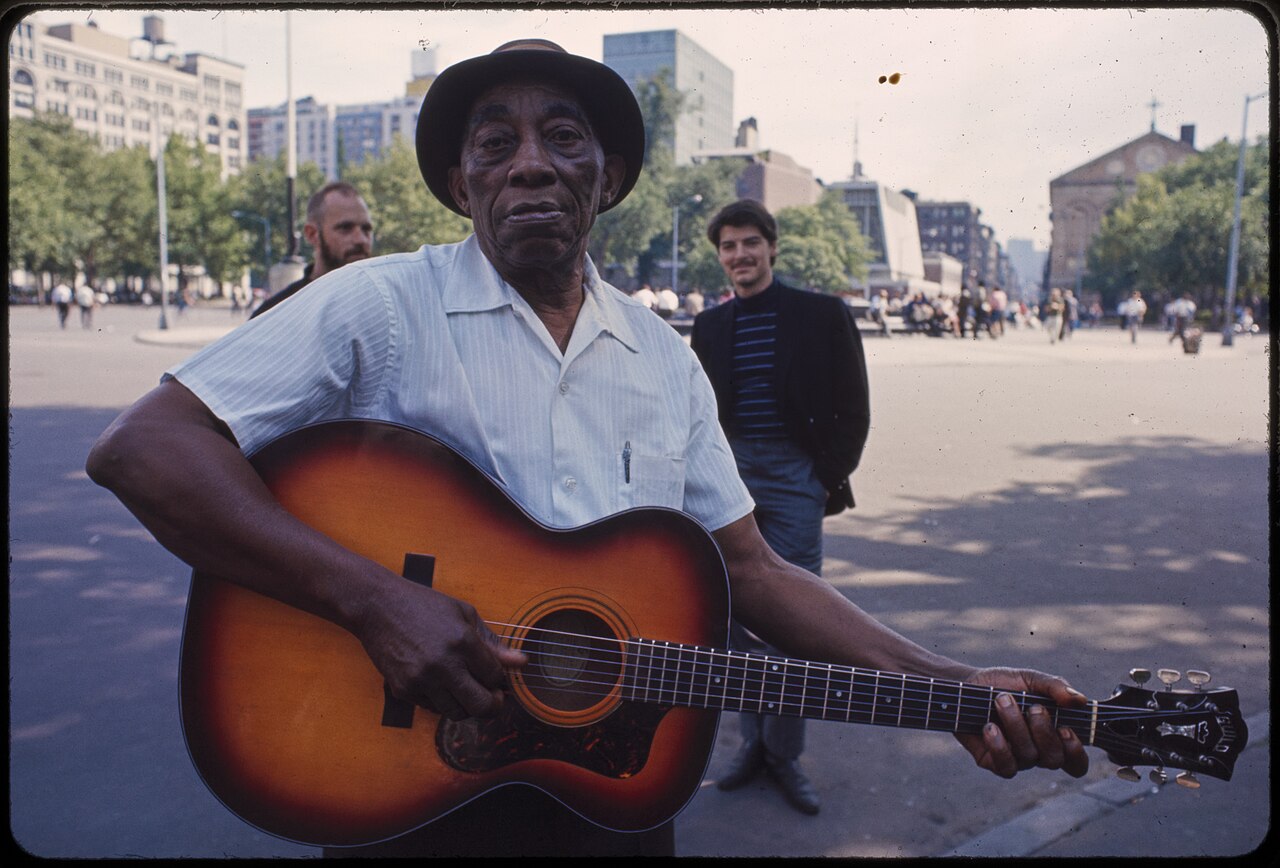
A man in a small Mississippi town picked up a guitar and played a few songs for a stranger who had come looking for him. The man was John Smith Hurt, a farmworker from Avalon, and the stranger wanted proof that he was the same Mississippi John Hurt who had once made records for a big label. That moment turned a forgotten sharecropper into one of the most beloved voices of the American folk revival. But the real question is how he had been lost at all. The answer begins with a quiet death in a hospital in Grenada, Mississippi.
From Teoc to the Okeh sessions
Hurt was born in Teoc, Mississippi, and grew up in Avalon, where his parents, Isom and Mary, worked as sharecroppers on a plantation. By the time he was nine, he had picked up the guitar on his own, and his syncopated style was made for dancing. For years he played old-time music at local dances and in the town store, while earning his living as a farmhand and sharecropper, sometimes on the railroad. All of that changed when a fiddler named Willie Narmour won a contest and got a chance to record for Okeh Records. Narmour recommended Hurt to the label's producer, Tommy Rockwell. Earlier, Hurt had performed with Narmour, filling in for his regular partner Shell Smith. He worked as a farmhand and sharecropper, sometimes on the railroad, into the 1920s.
Hurt auditioned at home with a song called 'Monday Morning Blues,' and the label liked what it heard. He went on to record twenty songs in Memphis and New York. The records sold moderately well, not only among Black listeners but also among white Southerners. Yet for Okeh, moderate sales were not enough. The label passed on further recordings, and when the Great Depression hit, Okeh folded. Hurt went back to Avalon and to sharecropping. For decades, that seemed to be the end of his music career.
The Anthology and the Avalon Blues search
But his music had not disappeared completely. A musicologist named Harry Smith included Hurt's versions of 'Frankie and Johnny' and 'Spike Driver Blues' in The Anthology of American Folk Music. Then someone found a copy of Hurt's old record 'Avalon Blues,' which set off a search for the man himself. A musicologist named Dick Spottswood located Avalon on a map and asked a friend, Tom Hoskins, who was traveling through the area, to find out about Hurt.
Hoskins found Hurt and asked him to play a few songs, to make sure he was the real Mississippi John Hurt. The guitar skills were still there. Hoskins persuaded Hurt to move to Washington and perform for a wider audience. In early 1963, Hurt recorded the album Folk Songs and Blues, released that August on Piedmont Records. The album helped spark a revival of American folk music and inspired searches for other bluesmen of his era. Hurt began playing at folk festivals in Newport and Philadelphia, and his popularity grew fast. He also recorded a live performance for radio station WTBS-FM in Cambridge, Massachusetts. He also recorded three albums for Vanguard Records, and much of his repertoire was captured for the Library of Congress.
For three years, Hurt performed constantly at colleges, concert halls, and coffeehouses. Audiences loved his ragtime songs like 'Salty Dog' and 'Candy Man,' as well as his blues ballads 'Spike Driver Blues' and 'Frankie.' His soft blend of country, blues, and old-time music felt both ancient and fresh. He appeared on 'The Tonight Show Starring Johnny Carson' and on Pete Seeger's television program 'Rainbow Quest.' A story about him ran in Time magazine. The quiet farmworker from Avalon had become a star.
Then Mississippi John Hurt died of a heart attack in a hospital in Grenada, Mississippi. The rediscovery had lasted only three years, but in that short time he had changed how a generation heard American roots music. His gentle fingerpicking and warm voice became a bridge between the old blues of the Mississippi Delta and the new folk clubs of the 1960s. Rolling Stone ranked Hurt 159th on its list of the 200 greatest singers of all time. The memorial and museum dedicated to him in Avalon was destroyed by fire the day after it became a national monument.
His gentle fingerpicking and warm voice became a bridge between the old blues of the Mississippi Delta and the new folk clubs of the 1960s.