
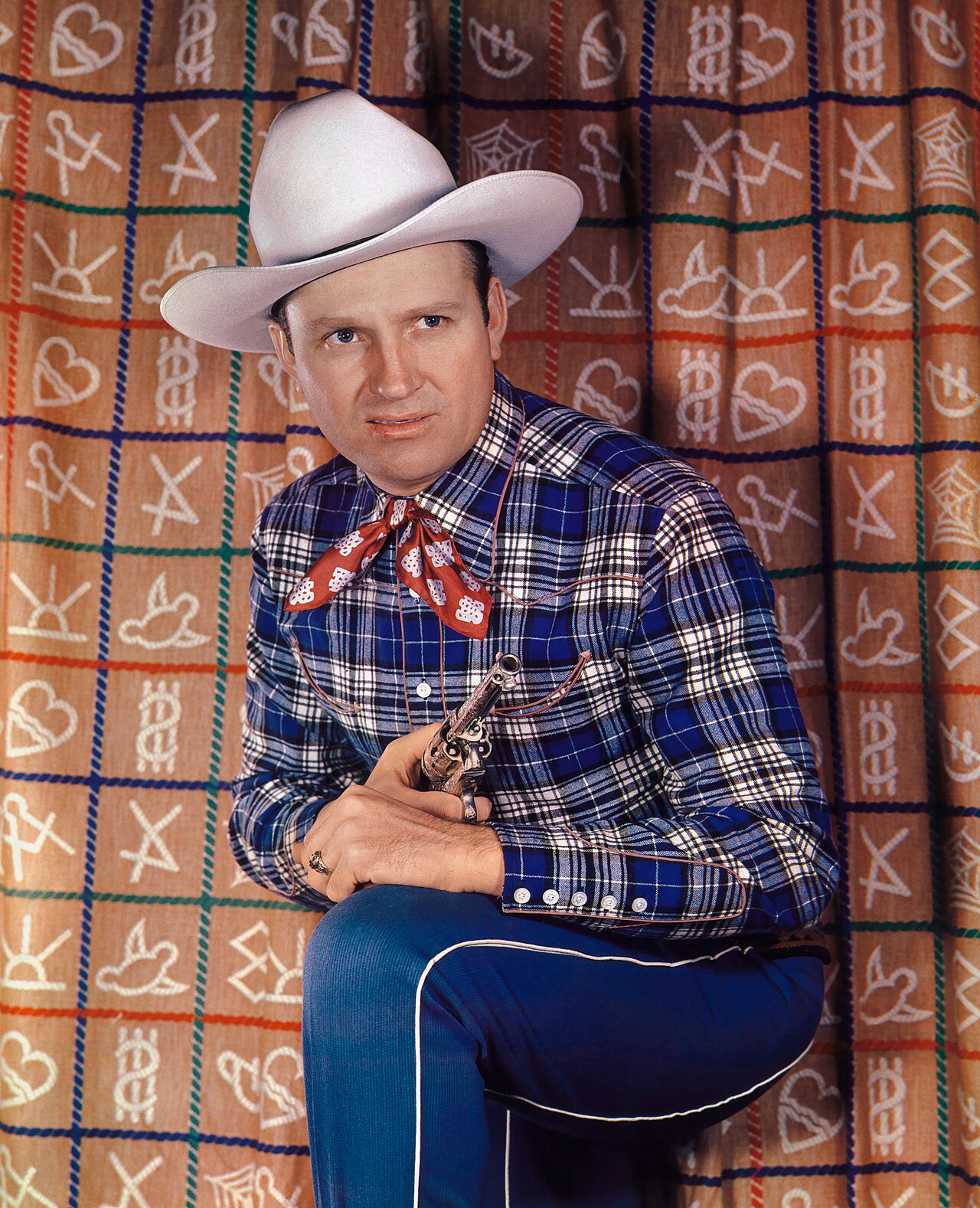
There is a version of American entertainment that began with a man singing into the dark from a railroad depot in the middle of Oklahoma. Gene Autry was born Orvon Grover Autry on September 29, 1907, in Tioga, Texas. Before he became the Singing Cowboy, before the films and the baseball team, he worked the night shift for the St. Louis–San Francisco Railway as a telegraph operator. The job came with long stretches of silence, and Autry filled them with a guitar and whatever songs he could remember. His employer eventually fired him for it. The firing did not slow him down; it simply removed the last obstacle between Autry and a microphone.
The firing did not slow him down; it simply removed the last obstacle between Autry and a microphone.
From telegraph to yodeling cowboy
Autry started that railroad work in 1925, at a moment when radio was turning regional performers into national names. His singing caught the attention of Will Rogers, who heard him and told him to pursue music professionally. By 1928 Autry was on KVOO in Tulsa, billing himself as Oklahoma's Yodeling Cowboy. A year later he signed with Columbia Records, and in 1932 he released the song that changed his trajectory: "That Silver-Haired Daddy of Mine." Autry co-wrote it with Jimmy Long, and the record gave him his first hit. The song's sentimentality and yodeling set a template for the career that followed.
The numbers attached to Autry's recording career are still difficult to absorb. He made 640 recordings and wrote or co-wrote more than 300 songs. His records sold over 100 million copies, and he collected more than a dozen gold and platinum certifications. Autry recorded the first certified gold record in history. Those figures came long before the modern era of instant multiplatinum releases, when a country singer selling a million copies of anything was considered remarkable. Autry did it repeatedly, across western songs, ballads, and holiday material that still resurfaces every December.
Christmas songs that defined a season
Christmas music became one of Autry's most durable contributions. He recorded "Rudolph, the Red-Nosed Reindeer" and "Frosty the Snowman," two songs that transformed seasonal radio. The origin of "Here Comes Santa Claus" was a parade in 1946. Autry was riding through the streets, listening to children shouting out for Santa, and those calls became the rhythm and hook of the song. He wrote it from that moment, turning crowd noise into a melody. The track arrived on Columbia, and its simplicity made it an immediate addition to the holiday canon.
Film gave Autry a second stage almost by accident. In 1934 producer Nat Levine discovered Autry and his partner Burnette. Autry's screen debut came that year in "In Old Santa Fe," where he appeared as part of a quartet of singing cowboys. The next year he landed the lead in the serial "The Phantom Empire," and from 1935 to 1940 he made 44 films for Republic Pictures. By 1940 he was the studio's biggest star. His horse Champion, a Morgan, became as recognizable as Autry himself, and the films gave the Singing Cowboy a visual identity to match the voice on record.
Building a trusted persona
Autry understood that fame required rules, especially for young listeners. He created a Cowboy Code of ten principles for his fans, a kind of moral framework printed and distributed to children who wrote to him. The code covered honesty, fairness, and respect. It was part of a larger media operation that included the CBS Radio program "Gene Autry's Melody Ranch," which ran weekly from 1940 to 1956. Autry was not merely a performer; he was building an institution around a persona that parents trusted and children imitated.
World War II interrupted the momentum. Autry served in the U.S. Army Air Corps, earned his pilot qualification, and flew C-109 aircraft over the Himalayas. After the war he left Republic in 1947 and moved to Columbia Pictures, where Pat Buttram became his new on-screen sidekick. In 1951 Autry founded his own studio, Flying A Productions, and from 1950 to 1956 he starred in the television series "The Gene Autry Show." The shift from radio and film to television kept him in American living rooms during the medium's first decade.
Autry's business instincts extended far beyond performance. He bought Monogram Ranch in 1953 and renamed it Melody Ranch, though a fire in 1962 destroyed most of the sets. He owned radio stations and a television station in Southern California, and in the 1950s he founded Challenge Records, the label that released "Tequila" by The Champs. From 1961 to 1997 he owned the California Angels baseball team. The singing cowboy had become a media executive, a label owner, and a sports franchise holder without ever surrendering the name that started it all.
The recognition arrived in layers. Autry entered the ProRodeo Hall of Fame in 1979, and he remains the only person with stars in all five categories on the Hollywood Walk of Fame. He is a member of the Country Music Hall of Fame and the Nashville Songwriters Hall of Fame. A town in Oklahoma carries his name. Gene Autry died on October 2, 1998, in Los Angeles at age 91. The railroad night shift in 1925, the firing, the advice from Will Rogers, and the first yodel on KVOO now sit 101 years behind the legacy they produced.