
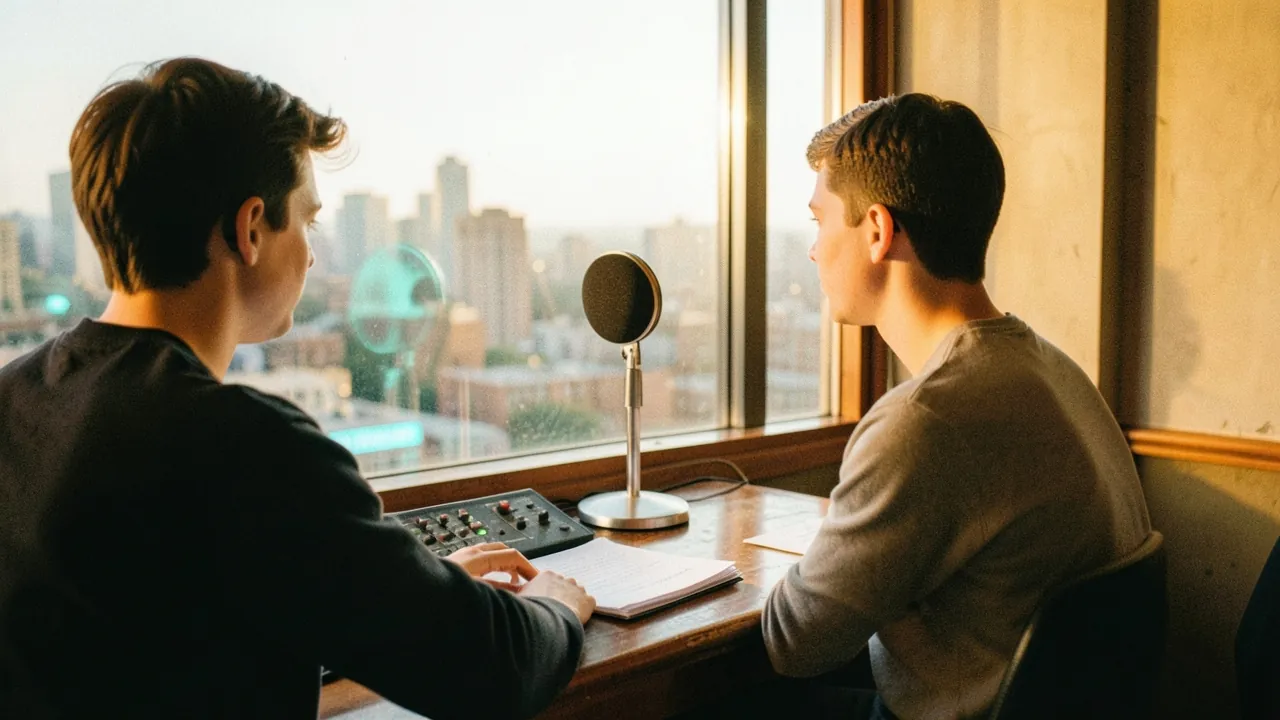
A single piano note hangs in a London studio, then splits into four harmonized versions of itself. That was the moment James Blake stopped being a dubstep producer and became something harder to categorize. Born on 26 September 1988, the British musician, singer, songwriter, and producer built a career on rearranging silence into emotional architecture. His music blends electronics, soul, and R&B into forms that feel both fragile and rigorously engineered.
That was the moment James Blake stopped being a dubstep producer and became something harder to categorize.
Early years and formal training
Blake grew up with a musician father, which shaped his early interest in sound before he ever touched a stage. He started writing music as a teenager, drawing on jazz and classical foundations rather than club trends. Formal training came at a music school in London, where piano and synthesis became his primary tools. Those years gave him a harmonic vocabulary that later set his minimal arrangements apart from the bass-heavy scene around him.
His first releases arrived through R&S Records, a label with deep roots in electronic music. The early EPs documented a producer still working through dubstep mechanics while reaching for something more melodic. 'Air & Lack Thereof' appeared in 2009 as his debut single, a track built from looped vocals and sparse percussion. It signaled a shift away from genre expectations toward a sound where negative space carried as much weight as the notes themselves.
The debut that changed the conversation
The self-titled debut album James Blake arrived in 2011 and changed the conversation around electronic soul. Its tracks leaned on processed, harmonized vocals and minimal arrangements, with piano chords dissolving into synthetic textures. The record earned a Mercury Prize nomination, placing Blake alongside the most inventive British releases of that year. Critics heard intimacy where others heard production tricks, and the album's restraint became its signature.
Overgrown followed in 2013 and turned critical admiration into institutional recognition. The album won the Mercury Prize, cementing Blake's position as a songwriter whose emotional directness could survive electronic manipulation. 'Retrograde' emerged as one of his most famous tracks, a slow-building meditation on devotion and distance. Around this period, his remixes for other artists also gained recognition, extending his influence beyond his own catalog.
Expanding the sonic palette
By 2016, The Colour in Anything arrived with a wider sonic palette and higher-profile collaborations. Blake had already worked with Beyoncé, Kendrick Lamar, and Frank Ocean, placing his voice inside some of the most ambitious R&B and hip-hop projects of the decade. His own album stretched across piano ballads and fractured beats, while his vocals remained processed and harmonized throughout. The emotional core stayed intimate even as the production expanded.
Assume Form appeared in 2019, marking another evolution. The record included collaborations with Travis Scott and Rosalía, pulling Blake toward more direct pop structures without abandoning his minimal approach. That same year he won a Grammy for Best R&B Performance, after several nominations in previous cycles. He also played major festivals including Coachella and Glastonbury, where his live sets translated studio precision into looping, layered performances.
Parallel work as DJ and remixer
Blake's work as a DJ and remixer runs parallel to his albums. He has appeared on records by JAY-Z and Kanye West, and his production partnership with Rick Rubin pushed him toward rawer, less polished textures. Several of his singles charted in the UK, while his music found its way into film and television soundtracks. He plays guitar and bass as well as keys, building live loops that reconstruct his studio sound in real time.
Friends That Break Your Heart came in 2021, followed by Playing Robots into Heaven in 2023. The latter was well received by critics, returning to club-oriented rhythms while retaining his emotional directness. His albums have frequently been pressed on vinyl, from the R&S-era EPs through the major-label releases. The catalog now spans more than a decade of shifting formats and consistent experimentation.
Blake still records and performs actively, supports independent labels, and appears at benefit concerts. His trajectory from teenage jazz and classical study to Grammy-winning R&B performance runs through every major shift in electronic music since 2009. The Mercury Prize years remain a useful marker: Overgrown sits at the center of a discography that keeps refusing to settle.