
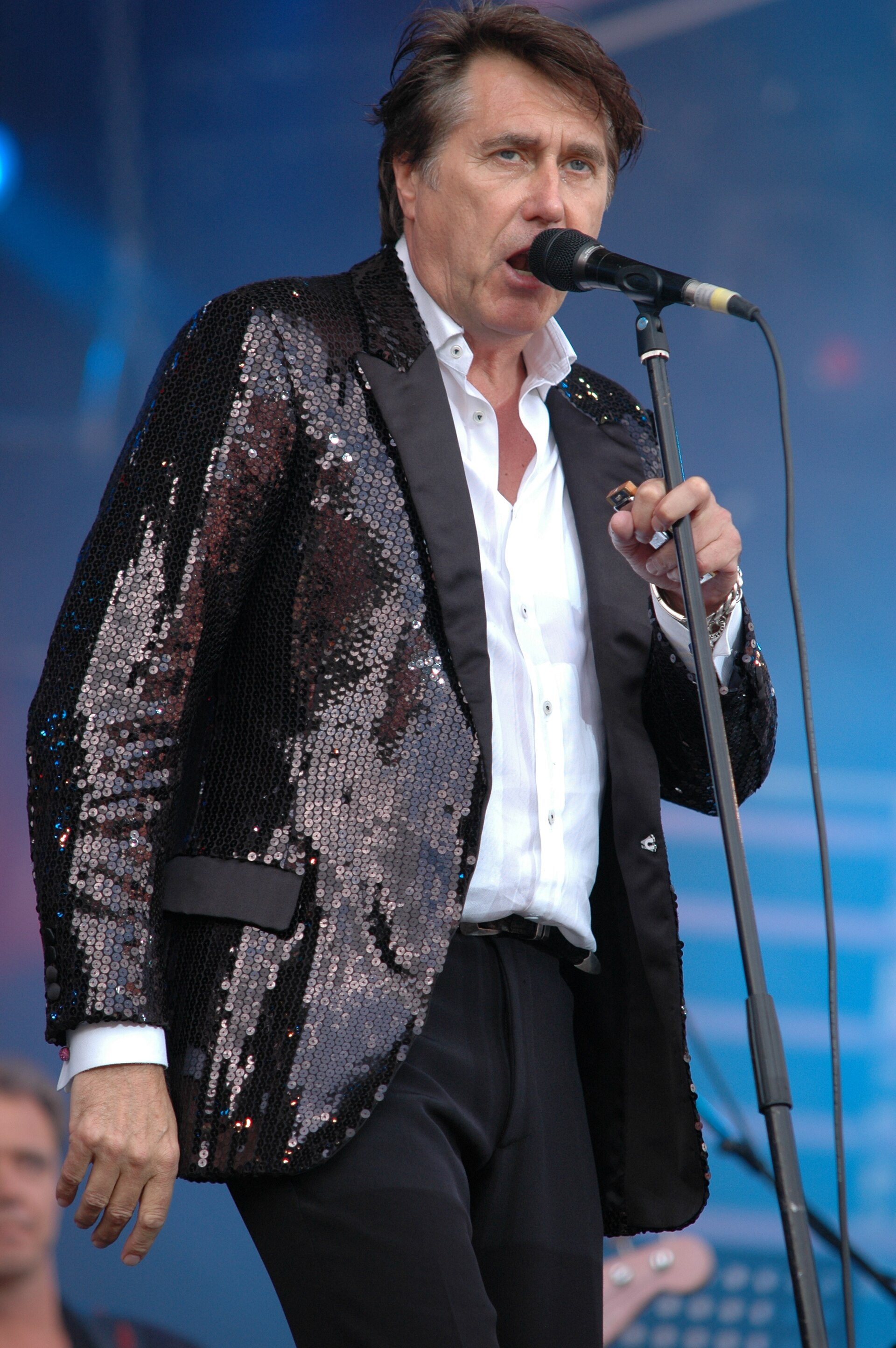
A zebra crossing on a London road became one of the most photographed strips of asphalt in history, yet the man born exactly twenty-four years to the day before that Beatles cover shoot was busy building a different kind of iconography. Bryan Ferry, born on 26 September 1945, would spend the late 1960s assembling a band that treated pop music as a canvas for avant-garde collage, not just a vehicle for melody.
Roxy Music's artful pop
As Roxy Music's vocalist and primary songwriter, Ferry dragged glam, art school pretension, and old Hollywood nostalgia into the same room. The group's early 1970s records arrived like fashion editorials with guitar solos, and Ferry's croon — half trembling romantic, half ironist — gave the material its peculiar tension. He was never simply a singer; he was a stylist who understood that surface could carry meaning.
He was never simply a singer; he was a stylist who understood that surface could carry meaning.
The date of Ferry's birth shares space with a strange cluster of musical turning points. On 26 September 1969, The Beatles released Abbey Road in the United Kingdom, their eleventh studio album and the final set of songs the four members recorded together in a studio. Those sessions began just three weeks after work wrapped on Get Back, the project later released in 1970 under the title Let It Be.
Abbey Road's chart triumph
Abbey Road topped album charts in both the UK and the US, where it appeared on 1 October 1969. The record included Come Together, Here Comes the Sun, and Something — the latter becoming the first Beatles A-side single written by George Harrison. The famous cover image of the four walking across that crossing became inseparable from the music itself.
Ferry's own catalogue invites a similar kind of obsessive listening. Roxy Music's run through the 1970s produced records that shifted shape from album to album, incorporating synthesizer textures, saxophone lines, and Ferry's increasingly polished vocal performances. His solo career ran parallel, blurring the line between covers interpreter and original songwriter.
U2's vanishing debut
The same late-September calendar holds other vinyl-worthy moments. In 1979, U2 released their debut EP Three, containing Out of Control, Stories for Boys, and Boy/Girl. All 1000 copies of the 12-inch pressing sold immediately, making Three the fastest-selling 12-inch release in Ireland at that point. A band that would later dominate arenas began with a tiny pressing run that vanished on contact.
Pink Floyd's American debut belongs to this date as well. In 1967, the group finally played their first US shows at the Fillmore in San Francisco. Formed in 1965, Pink Floyd had delayed crossing the Atlantic because of Syd Barrett's health problems. The Fillmore engagement marked the beginning of a relationship with American audiences that would eventually reshape progressive rock.
Bessie Smith's legacy
Further back, 26 September carries the memory of Bessie Smith, who died in 1937 at the age of 43 following injuries from a car accident. Known as the Empress of the Blues, Smith recorded Downhearted Blues, The St. Louis Blues, and After You've Gone. Her songs carried direct social commentary about working-class struggle, women's lives, and Black American experience, making her one of the most influential figures in blues history.
Ferry's birthday also brushes against later rock milestones. In 1995, AC/DC released Ballbreaker, their twelfth international studio album, produced by Rick Rubin and featuring the return of drummer Phil Rudd. Rudd had been fired in 1983 amid alcohol and drug problems, plus a fight with Malcolm Young. His comeback on Ballbreaker restored a rhythmic foundation the band had been missing.
The date even touches 1981, when Bruce Dickinson joined Iron Maiden after fronting Samson. That single personnel change redirected heavy metal's trajectory. For Bryan Ferry, born on this crowded day, the legacy is quieter but no less persistent: Roxy Music's catalog remains a standard for listeners who want rock music that thinks, poses, and still delivers the chorus.