
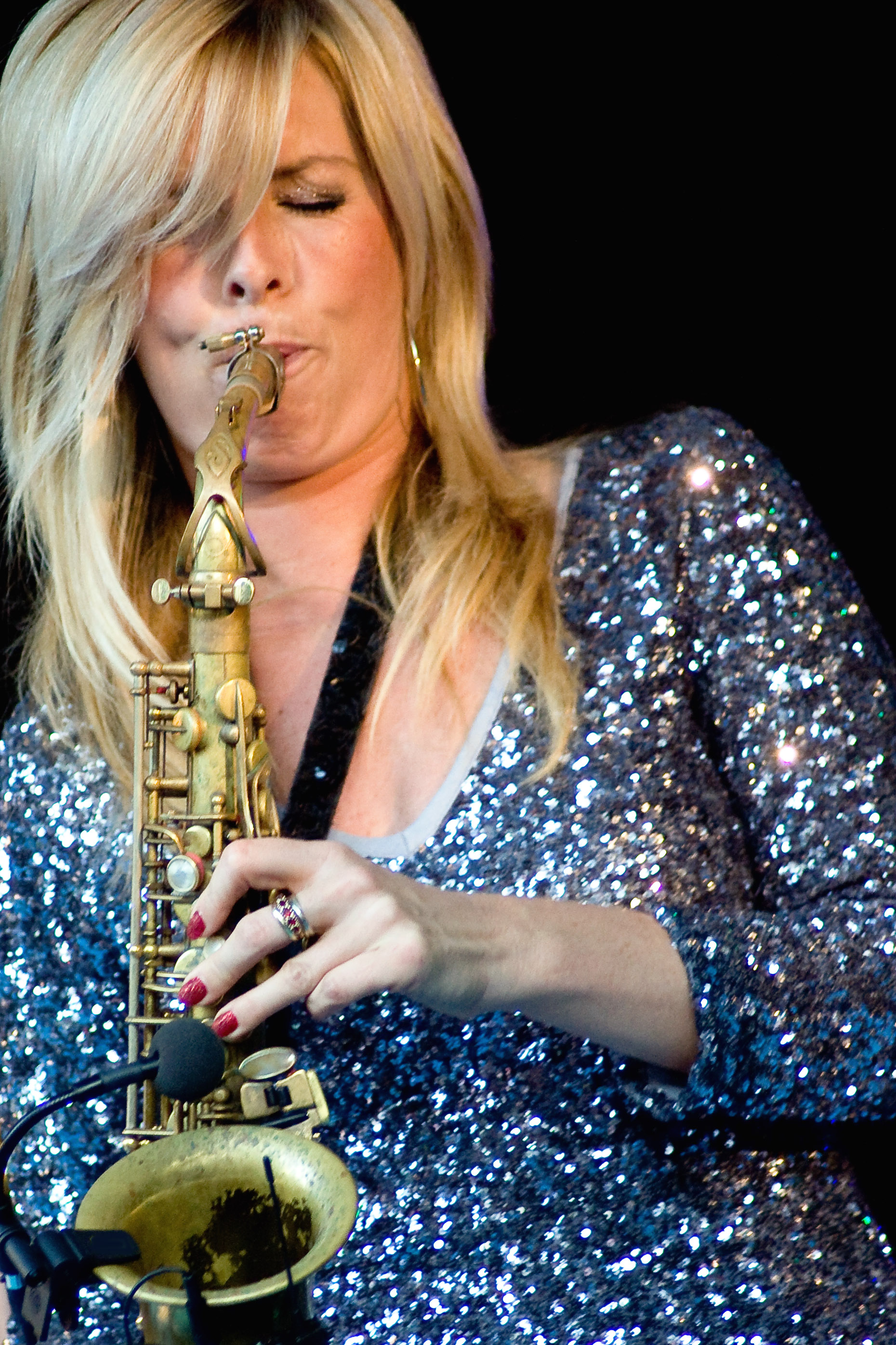
A fourteen-year-old steps onto a stage in Zuiderwoude, counts off the band, and plays her first solo. The drummer keeps time, the bass locks in, and the alto sax cuts through the room. Candy Dulfer was born in Amsterdam on September 19, 1969, and by the time she hit her teens, she already had her own group, Funky Stuff, and a father who treated the family living room like a jazz conservatory.
A childhood in jazz
Hans Dulfer, a respected Dutch tenor saxophonist, filled the house with Sonny Rollins, Coleman Hawkins, and Dexter Gordon. Candy didn't start on sax, though. At five, she sat behind a drum kit. At six, she picked up the soprano sax. At seven, she switched to alto and never looked back. The local concert band Jeugd Doet Leven gave her ensemble experience, but the real education came from watching her father's band, De Perikels, from the wings.
That first solo with De Perikels wasn't a one-off. Candy kept showing up, kept playing, and by fourteen she was leading Funky Stuff through funk and jazz sets around the Netherlands. The group gave her something rare for a teenage saxophonist: a working repertoire, real audiences, and the confidence to treat the stage as her natural habitat. No music school could replicate that.
The Madonna tour break
The break came in 1987, when Madonna's European tour needed an opening act. Candy Dulfer, still a teenager, got the slot. Suddenly, arenas full of pop fans heard a young Dutch saxophonist tearing through jazz-funk lines before the main event. The exposure was massive, but the real turning point arrived two years later, in November 1989, when she co-wrote a track with Dave Stewart called 'Lily Was Here'.
The song was written for Ben Verbong's film 'De Kassière' (The Cashier), and it did something unusual for an instrumental saxophone piece: it became a pop phenomenon. On November 25, 1989, 'Lily Was Here' climbed to the top of the Dutch Top 40 and stayed there for six weeks, holding the number one spot until December 30. Norway pushed it to second place on its singles chart, and the UK sent it to sixth.
On November 25, 1989, 'Lily Was Here' climbed to the top of the Dutch Top 40 and stayed there for six weeks, holding the number one spot until December 30.
Global chart success
By summer 1990, 'Lily Was Here' had crossed the Atlantic and landed at number eleven on the Billboard Hot 100. A saxophone instrumental, co-written for a Dutch film, was suddenly a global hit. That same year, Dulfer released her debut album, Saxuality, on Bertelsmann Music Group. The record earned a Grammy nomination and established her as a solo artist with a sound that bridged jazz and pop without apology.
The collaborations that followed read like a map of late-century music. She worked with Prince, the artist who famously blurred every genre line she also crossed. She recorded with Van Morrison, Angie Stone, Maceo Parker, and Rick Braun. In 1990, she joined Pink Floyd on stage. In 1995, Alan Parsons brought her in. In 2014, she stood with Tower of Power, a band whose horn section defined funk for decades.
Family and television career
Dulfer never abandoned her father's world. She performed and recorded with Hans Dulfer throughout her career, keeping the family's saxophone dialogue alive on stage and in the studio. The jazz she grew up with—cool, melodic, rhythmically sharp—remained the foundation, even as pop hooks and television appearances widened her audience. She became a presenter, hosting the Dutch show 'Candy Meets...' in 2007, where she interviewed fellow musicians.
In 2013, she took a judge's seat on the fifth season of the Dutch X Factor, bringing a working musician's ear to a format built on spectacle. Fifty-seven years after her birth in Amsterdam, Candy Dulfer still moves between worlds: jazz purist and pop hitmaker, bandleader and broadcaster, the kid from Zuiderwoude and the woman who once made a supermarket film's soundtrack a chart-topping single.
The alto sax she switched to at seven became her signature. The drum kit she abandoned at five taught her rhythm first. The records her father played taught her melody. Somewhere in that combination—drums, Rollins, a Dutch concert band, a Madonna tour—a sound formed that no one else could claim. 'Lily Was Here' was the proof, but the playing never stopped.