
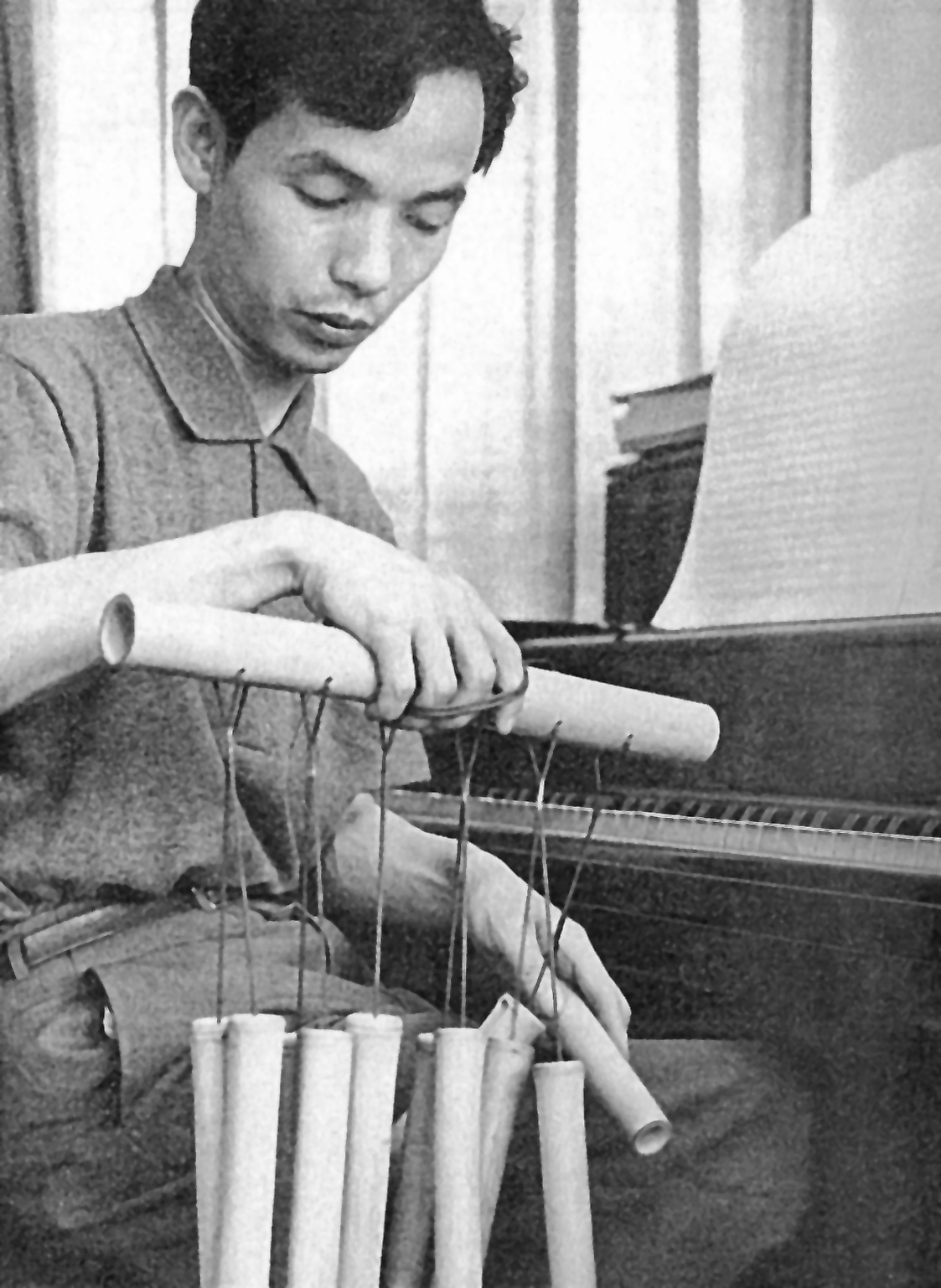
Toru Takemitsu was born in Tokyo on 8 October 1930, and for the first six years of his life he lived in Dalian, Manchuria, where his father worked as an official. That early displacement matters less than what happened when he was 14: he was conscripted to work on a military base in Saitama Prefecture. There, by chance, he heard a French song, "Parlez-moi d'amour," and for the first time Western music entered his ears. He had no musical education, yet at 16 he began composing. The composer Toru Takemitsu built his entire career on that accidental encounter, turning a wartime labor assignment into the seed of one of Japan's most distinctive musical voices.
From rejection to the Experimental Workshop
The path was not smooth. In 1950, the first public performance of his work Lento in due movimenti was harshly criticized. A young man with no formal training had dared to present something to the Japanese musical establishment, and the response was rejection. But Takemitsu did not retreat. A year later he became one of the founders of Jikken Kobo, the Experimental Workshop, a group that brought together composers, artists, and poets. That collective gave him a place to develop ideas outside the conservative mainstream, and it marked the start of his serious commitment to the avant-garde.
At first, Takemitsu rejected Japanese traditional music and threw himself into Western styles. That stance began to shift in 1956, when he became interested in traditional Japanese music and started using its instruments. The change was not a rejection of the West but an expansion: he wanted both worlds in the same room. In 1962 he wrote music for the film Harakiri, using the biwa, a Japanese lute. Five years later, in 1967, he created November Steps for biwa, shakuhachi, and orchestra, commissioned by the New York Philharmonic. The premiere was conducted by Seiji Ozawa, and it placed two ancient Japanese instruments inside a modern Western orchestra, a move that defined his mature style.
The change was not a rejection of the West but an expansion: he wanted both worlds in the same room.
Stravinsky's endorsement of the Requiem
The international breakthrough had come earlier, through a single work. In 1957, his Requiem for String Orchestra attracted international attention. The following year, Igor Stravinsky heard the Requiem during a visit to Japan and praised it highly. Stravinsky then told Aaron Copland and other musicians about Takemitsu after returning to the United States. That endorsement changed everything: a composer who had been mocked in 1950 now had the attention of one of the century's most influential figures. It opened doors to commissions and performances far beyond Japan.
Takemitsu's film work became another bridge. He wrote music for more than 90 films, collaborating with directors such as Hiroshi Teshigahara, Akira Kurosawa, Masaki Kobayashi, Shohei Imamura, and Nagisa Oshima. The waltz from the film The Face of Another gained wide popularity, showing that his experimental language could reach a broad audience. Film gave him a steady creative outlet and a way to test ideas quickly, while his concert works continued to explore the meeting of East and West.
The composer Toru Takemitsu died in Tokyo on 20 February 1996 at the age of 65. He left behind a body of work that had moved from harsh early rejection to international acclaim, from a boy who heard a French song on a military base to a figure whose music joined biwa and shakuhachi with the Western orchestra. The accidental song on the base did not make him a composer, but it opened a door he never closed.