
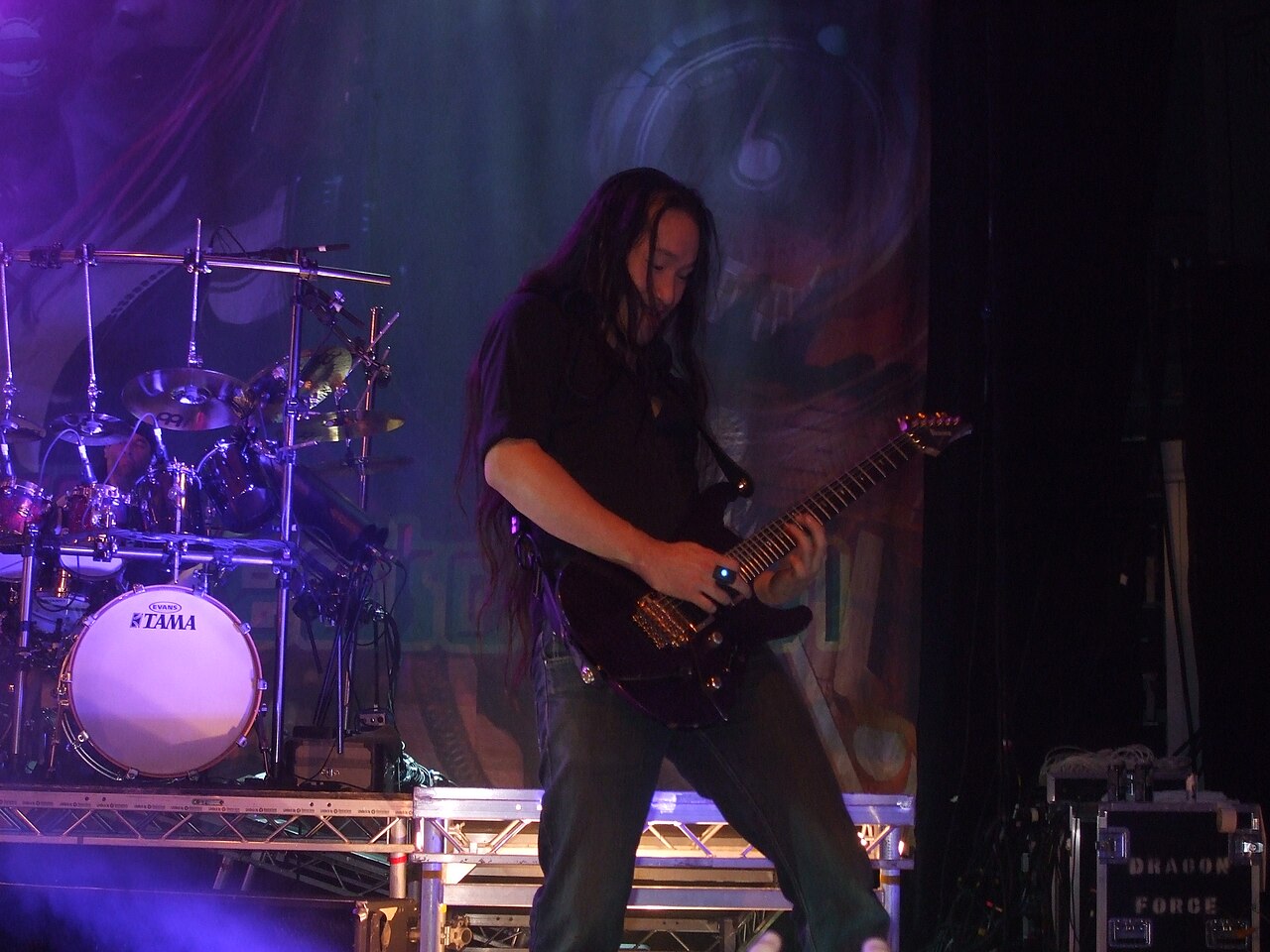
In a Hong Kong childhood, long before stadium stages, Herman Li was already hearing music where most people heard noise: the bleeps, jumps and coin-grabs of arcade cabinets. Born in Hong Kong on the third of October, 1976, Li would grow into the lead guitarist, producer and songwriter of DragonForce, the English power-metal band known for playing faster than almost anyone. But the sounds that shaped him were not only riffs. They were the electronic chirps of late-1980s and early-1990s video games, and he never tried to hide that.
From Demoniac to DragonForce
The road to DragonForce was not a straight line. As a teenager, Li moved to France and then to England, carrying a love for metal that was still finding its shape. By 1993 he had started his musical career, and soon he was playing in a black-metal group called Demoniac alongside Sam Totman. That friendship mattered more than the genre. When the two of them founded DragonForce in England in 1999, they left the darkness of black metal behind and built something brighter, faster and far more theatrical.
From the start, Li was not just a guitarist. He was one of the band's two remaining original members, and his role stretched across writing, producing and leading the music. His style pulled from every corner of metal, but it also reached somewhere unexpected: the games he had loved as a kid. He often imitates sounds from popular arcade and computer games of the late 1980s and early 1990s, turning a guitar solo into something closer to a level-up jingle than a traditional rock statement.
Arcade sounds inside a solo
That playful approach became world-famous through one song. In 'Through the Fire and Flames', Li recreates sounds from the Mario game series, and he and Sam Totman trade twin guitar solos at a pace that feels almost impossible. His technique is built for that speed: rapid legato and staccato runs, sweep-picked arpeggios, tapping and every other shred trick in the book. Yet the secret is not only speed. It is the joy of making a guitar behave like a machine from an amusement arcade.
Yet the secret is not only speed. It is the joy of making a guitar behave like a machine from an amusement arcade.
The song took on a life of its own when it appeared in Guitar Hero III: Legends of Rock. Suddenly, millions of players were not just hearing Li's solos; they were trying to survive them. The single went platinum in the United States, and the album Inhuman Rampage earned gold there and silver in Britain. A guitarist who had once played black metal in a small scene was now the face of a challenge that living-room gamers bragged about beating.
Awards followed the game's success. Li won the Metal Hammer Golden Gods award for best shredder, and his solo in 'Through the Fire and Flames' was celebrated by readers of guitar magazines. The recognition was not for moody artistry but for something rarer: technical brilliance that still sounded like fun. He is left-handed but plays a right-handed guitar, a small detail that hints at how naturally the instrument fits him, even when he is pushing it to its limits.
Fifty years after his birth, Herman Li remains a guitarist who refuses to separate metal from play. The arcade sounds of his childhood became a signature, and a song built on those sounds became a test of skill for a generation of gamers. He did not just play fast. He made speed feel like a game worth playing.