
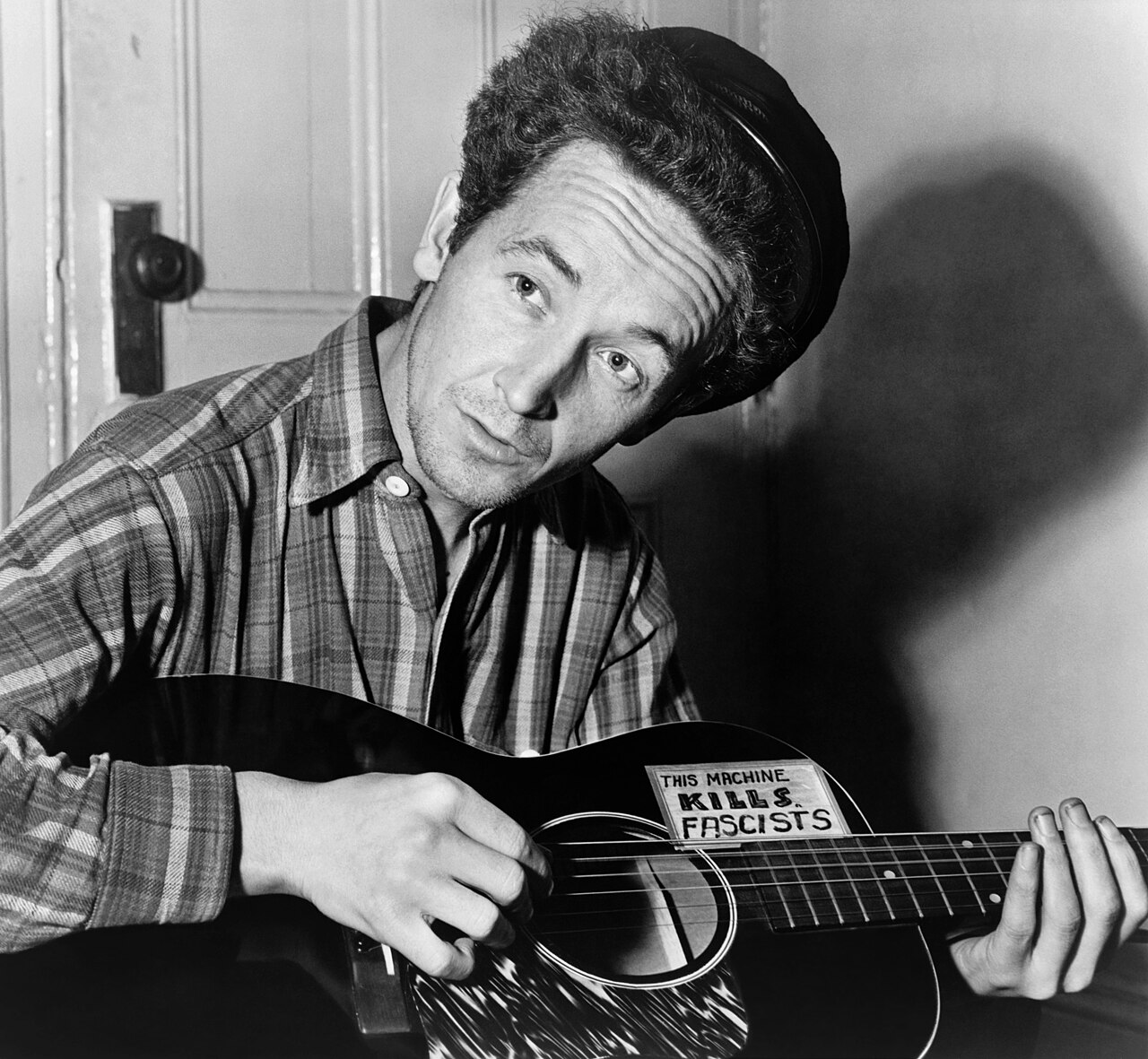
The first thing you need to know about Woody Guthrie is that he wrote the most famous American folk song almost by accident, as an annoyed reply to a tune he could not escape on the radio. The Oklahoma-born singer had been hearing Irving Berlin's 'God Bless America' everywhere, and he decided the country needed a different kind of anthem. The result, 'This Land Is Your Land', would take decades to become the standard it is now, but its origins were scrappy, personal and a little bit sarcastic.
By the time he wrote that song, Guthrie had already earned a nickname that stuck for the rest of his life: the Dust Bowl Troubadour. It came from an album he recorded in 1940, Dust Bowl Ballads, a set of songs built on what he had seen during the hardest years of the Great Depression. He had not studied music formally. He taught himself guitar and harmonica, and he left school before getting a diploma, which meant his education came from freight trains, migrant camps and the desperate families he met on the road.
Leaving family for California
The road had pulled him away from a settled life early. Guthrie was married, with children, when the Depression tightened its grip on the plains. Instead of staying put, he left his wife and kids behind and pointed himself toward California, where thousands of displaced farmers were looking for work. He landed in Los Angeles and found a spot on radio station KFVD, playing hillbilly and folk songs for an audience that understood exactly what he was singing about.
That radio work gave him a platform, but the songs themselves carried the weight. Dust Bowl Ballads was a record about displacement, dust storms and the broken promises of the West, and it made Guthrie a voice for people who rarely had one. The nickname stuck because it was accurate: he was a troubadour in the old sense, a wandering singer who carried news and stories from place to place, except his news was about foreclosures and empty pantries.
Writing 'This Land Is Your Land'
When he sat down to write 'This Land Is Your Land', he borrowed the melody from a gospel song called 'Oh My Loving Brother', which gave the new lyrics an easy, singable shape. The words were a direct answer to 'God Bless America', but they were not a parody. Guthrie was offering a different map of the country, one that included the people Berlin's song left out. He did not record the song right away. The first recording came only in 1944, made for Moses Asch, the man whose label would later preserve so much of Guthrie's work.
By the time that recording happened, Guthrie had become something more than a regional radio singer. He had written hundreds of songs, carried a guitar with a sticker that read 'This machine kills fascists', and turned his life into a book, Bound for Glory. The title mattered. Guthrie saw himself not as a victim of the Depression but as someone who had come through it with stories to tell. That confidence, more than any single song, is what drew younger musicians to him.
The younger generation found him in person. In the early 1960s, a young Bob Dylan visited Guthrie in the psychiatric hospital where he was spending his final years, brought there by the disease that had already killed Guthrie's mother. Huntington's disease had been shadowing the family for decades, and by then it had taken hold of Woody himself. Dylan came because Guthrie's songs had shown him what a folk singer could be: not a polished performer but a witness, a wanderer, a man with a guitar and a point of view.
Guthrie died in New York on October 3, 1967, at the age of 55, from complications of that same disease. He left behind a body of work so large that it is still being sorted through, and a song that schoolchildren sing without knowing its sarcastic origin. What he started on the road to California, what he shaped on a Los Angeles radio show, and what he wrote down in a burst of irritation at Irving Berlin, became the foundation of American folk music. The Dust Bowl Troubadour did not just document the country; he gave it a new way to sing about itself.