
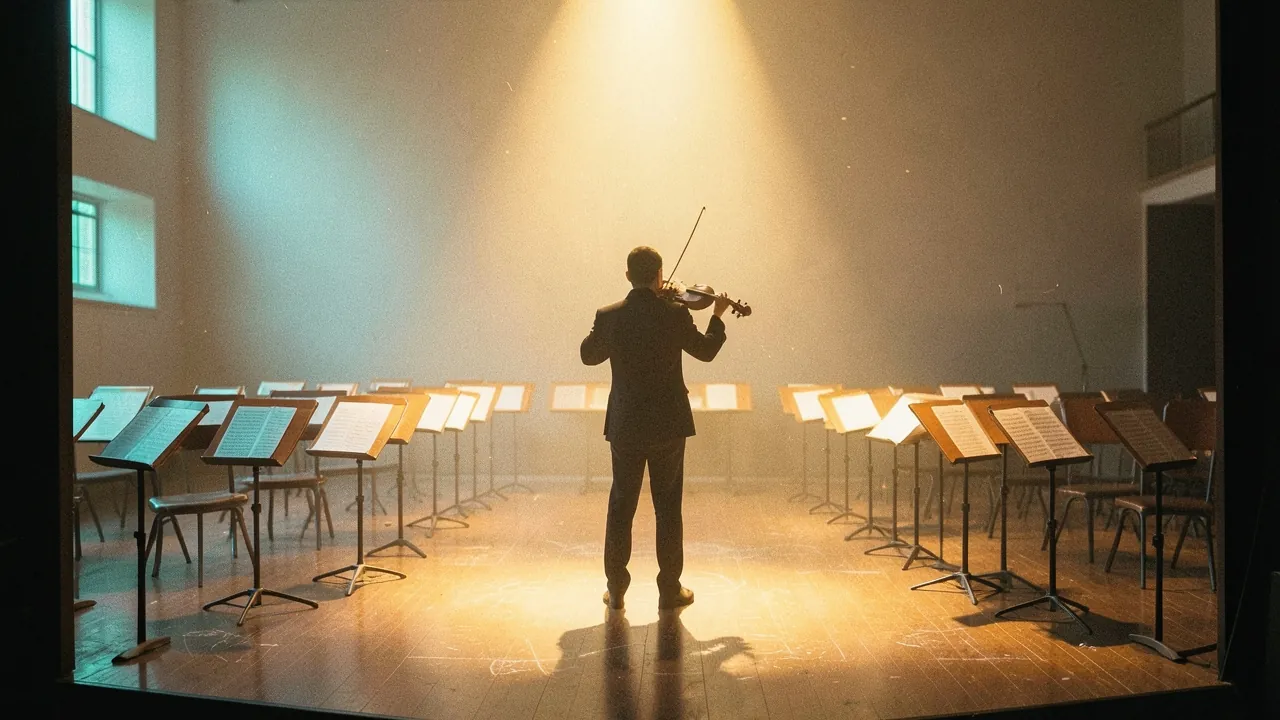
A boy of five takes up the violin under his father's instruction, and by eight he is already playing for an audience in La Coruña. Now consider the opposite trajectory: a man who spent decades at the top of his profession, a violinist celebrated from Paris to the Americas, still jokes that he once snatched the instrument from his own father's hands. The father, a military bandmaster, had been struggling for too long with a passage. The child played it flawlessly on the first attempt. Pablo de Sarasate's life reads like that scene repeated at escalating scale—he kept taking the violin from the hands of a world that thought the passage too hard.
A child prodigy's royal gift
The full name was Pablo Martín Melitón de Sarasate y Navascués, born in Pamplona on the tenth of March, 1844. His father was a military bandmaster, the kind of household where skill was expected early. But even by those standards, the pace was extreme. At eight years old, the first public concert in La Coruña had already happened. A local countess saw what was unfolding and funded the move to Madrid for formal study. That decision led to a private performance before Queen Isabella II, who responded with a gift that changed everything: a Stradivari violin.
With that instrument in hand, he arrived in Paris and entered the Conservatoire in 1854 as a raw talent, leaving in 1859 with first prizes in both his specialty and harmony. He had studied under Jean-Delphin Alard, the man who shaped a generation of French violinists. The Parisian solo debut came the following year, in 1860. From that point, the concert circuit of the nineteenth century opened up. His reputation built on two pillars that rarely coincide: a purity of tone so clean it sounded effortless, and a technical command that made other professionals uncomfortable.
Compositions built for the hands
Sarasate the composer is where the story bends. He wrote the kind of pieces that violinists still pull out when they need to prove something: the Spanish Dances, the fantasy on themes from Bizet's Carmen. His Zigeunerweisen—the Gypsy Airs—remains one of the most performed short violin works ever written. He also conducted, though the baton never displaced the bow. The compositions were extensions of his playing: direct, fiercely idiomatic, built to display exactly what his hands could already do better than anyone else's.
The ideal of Sarasate in performance was not the tormented Romantic artist wrestling with the sublime. It was clarity. Precision. A bow arm that made the hardest fingerings look like a natural language. Critics and audiences responded to that quality across continents. He was one of the first violinists of the modern touring era, his career spanning the second half of the nineteenth century into the twentieth. By the time he became ill in the first decade of the new century, the name was shorthand for a specific kind of impossible fluency.
It was clarity. Precision. A bow arm that made the hardest fingerings look like a natural language.
The final stillness in Biarritz
His death came on the twentieth of September, 1908, in Biarritz, the French coastal resort town where the Spanish aristocracy liked to escape the heat. He was 118 years from where we stand now, in 2026. For a musician whose entire identity was built on movement—the hand, the bow, the passage, the finishing flourish—the end was a sudden stillness. Biarritz is a strange place: a seaside town more associated with leisure than with finality. Yet that is where the story stopped.
What the violin actually contributes to this history is harder to measure than the biography suggests. Sarasate was not a composer searching for a voice. He was a player who wrote pieces for himself, and the pieces happened to survive because they worked. The fantasy on Carmen does not explore Bizet's opera so much as boil it down to a sequence of unanswerable technical questions. Every student fights through them. Almost no one emerges sounding like the original.
The recordings made of Sarasate's own playing, if they existed at all, would not capture what contemporaries described. But the compositions remain as an indirect fingerprint. They reveal a musician who thought in terms of effects that could silence a hall. The Stradivari from the queen traveled with him through all of it. Whether it sits in a museum now or passed into other hands is not the point—the instrument was never the source of the sound, only its amplifier.
He left no school of teaching, no method that bears his name. The pieces are studied, performed, bootlegged by every conservatory student in some form. But the specific quality that made audiences stand up and leave the theater changed—the thing itself, the sound in the room on a given night—is gone. The only question that remains is whether it ever belonged to him at all, or whether it was always something the audience brought into the hall and left with, impossible to keep.