
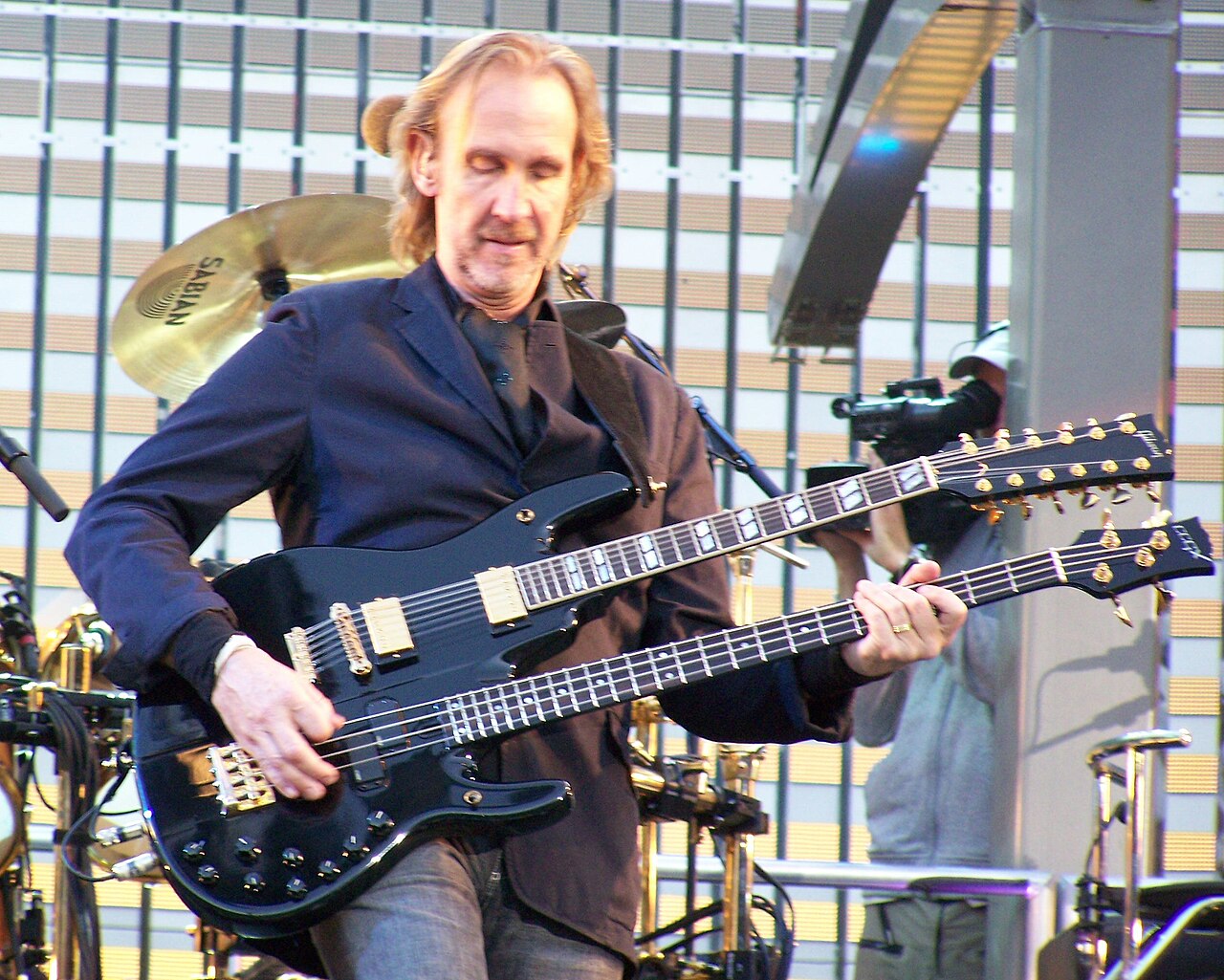
On stage in the early 1970s, Mike Rutherford of Genesis often had seconds to switch between a rumbling bass line and a chiming 12-string guitar part. His solution was not faster hands but a single custom instrument: a double-neck Rickenbacker that fused a 12-string semi-acoustic guitar and a four-string bass into one body. Rutherford, the English bassist and guitarist who co-founded the band, had been chasing that kind of practical magic since childhood.
From three chords to Genesis
His first instrument was a six-string acoustic guitar, a gift from his parents when he was seven. He later recalled that in the first year he learned just three chords, and that his fingers hurt badly enough to make it a miserable start. The discomfort did not put him off. By the time Genesis began recording and touring, Rutherford was handling bass, backing vocals, and most of the rhythm guitar work, often on a 12-string.
The early Genesis setlists were full of songs that demanded quick changes between low-end pulse and high, ringing arpeggios. Retuning a single guitar between songs took too long, so Rutherford commissioned the double-neck Rickenbacker. All those early double guitars were built by the luthier Dick Knight. The instrument did more than solve a logistics problem: the need to retune also gave singer Peter Gabriel time to develop the stories and theatrical introductions that became a signature of Genesis live shows.
Refining the double-neck design
Rutherford kept refining the idea. For different tours he used a 12-string Rickenbacker paired with a six-string baritone guitar, then moved to a combination of a 12-string and a six-string bass built from scratch. By the time Genesis reunited for a tour in 2007, he was still reaching for double-neck instruments whenever an arrangement required a fast switch between bass and 12-string guitar. His current double-neck pairs a 12-string Gibson with a Yamaha TRB-4P bass.
Outside that custom world, Rutherford has been practical about his gear. Since 1992 he has mostly played Yamaha TRB series basses. For late-career guitar parts he favours a Fender Stratocaster, specifically an Eric Clapton signature model. During the 2021–2022 tour with Genesis he began using a Squier Bullet Stratocaster, having bought a pair of them during lockdown in Cape Town.
Home in West Sussex and Cape Town
That city is one of two places Rutherford calls home. He and his wife Angie married in 1976 and have three children. The family splits time between West Sussex in England and Cape Town in South Africa, and they share a deep interest in horses, including polo, dressage, and breeding. The same man who spent decades solving stage problems with custom double-necks and bass pedals is just as comfortable around stables.
The double-neck obsession was never a gimmick. It grew from a specific need: Genesis songs moved between textures quickly, and Rutherford was often the person holding those textures together. His custom instruments let the band play long, shifting pieces without dead air. That reliability helped Genesis build a live reputation as a band that could pull off complex material night after night.
His custom instruments let the band play long, shifting pieces without dead air.
When Genesis took a break in the mid-1980s, Rutherford channelled his collaborative instincts into a new project, Mike + The Mechanics. The group gave him some of his biggest singles, including All I Need Is a Miracle, The Living Years, and Silent Running. It was a long way from the schoolboy who could barely manage three chords, but the same impulse was there: find the right tool, build the right sound, and keep the show moving.